

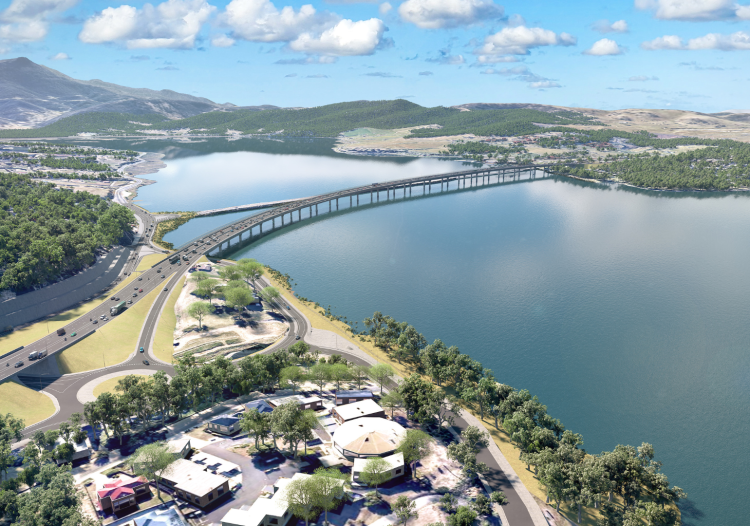
Spanning engineering, ecology and heritage, the award-winning Bridgewater Bridge has set new standards for bold urban infrastructure.
If you’ve driven past the Derwent River in Tasmania recently, you’ve probably noticed something big taking shape. The new Bridgewater Bridge, a project led by McConnell Dowell, is one of Tasmania’s largest and most ambitious transport upgrades to date, changing more than just the locals’ commute.
Peter Fraser, director of the project which opened to the public in June and has since won the prestigious 2025 Australian Construction Achievement Award, explained why it’s one of a kind.

Why replace the old bridge?
When the current Bridgewater Bridge officially opened in 1946, the steel truss lift-span structure was once considered cutting-edge. In fact, it was Australia’s first fully welded steel bridge.
But the need to replace the old bridge has been a long time coming. Over time, it aged beyond its intended lifespan.
“It was well past its use by date,” Fraser said. “From an economic perspective, the maintenance costs and risk of network disruption from failure were unsustainable. And it was getting to the point where it was no longer able to be maintainable.”
With just one lane in each direction, the old structure couldn’t support the volume or pace of today’s traffic. Connecting the Brooker Highway and Midland Highway, the expansion of Bridgewater Bridge to a four-lane thoroughfare standard was a modern, robust solution.
To avoid disrupting this delicate ecosystem, the team took a novel approach.
“We prefabricated 12 barges specifically for the project and then we ballasted them onto the mud flats. That enabled us to build the bridge from the platform where the barge is formed without disturbing the mud and the flora while providing reliable construction access.”
Read more: Forging a new route across the Murray River
Geotechnical challenges and sustainable approaches
Building across the Derwent presents serious geological obstacles. “It’s very highly faulted and has geologically variable rock,” Fraser said. “It’s also overlain by about 30 meters of very soft marine mud.”
To address this, the project team turned to a sophisticated piling method. “We adopted a mono pile for each pier, rather than pile groups, which was an innovative application of design.”

Sustainability was also an important consideration. The monopiles use less concrete, reducing overall material requirements. The barge platforms and temporary bridge structures are all reusable. And extensive prefabrication off-site has allowed for faster, more controlled construction, minimising waste.
“We’ve done an immense amount of prefabrication work that increases efficiency. Offsite construction, including 1082 box girder segments in a purpose-built precast yard – where we can do things in a controlled environment – means that we were able to again head towards lower carbon.”
Even at the civil works level, the team ensured materials excavated from site were reused, minimising waste and unnecessary transport. “We’ve ensured that we don’t export material we’ve excavated and then bring it back in again as a purchased material,” Fraser said. “We’ve optimised the cut and fill, and the use of material onsite.”

Honouring heritage, managing traffic
As with many Australian infrastructure projects, heritage considerations played a critical role here, with the site’s history stretching back millennia.

“There would likely have been a crossing here going back thousands of years,” Fraser said. “We found a number of Aboriginal artifacts in certain locations which have needed to be respectfully looked at and taken care of.”
At times, the team had to stop works and closely consult with the local community to ensure they were taking the right approach. There’s also significant European and colonial heritage on site which had to be carefully controlled, excavated, mapped and managed.
“The causeway was built by convicts, and there are various surrounding inns, hotels and railways,” he said.
Aboriginal and European heritage archeologists were employed and worked closely with the team throughout the project.
Traffic impacts were also an ongoing challenge, leading to some congestion. But with real-time monitoring and careful phasing, disruptions have been kept to a minimum.
“We’ve been able to keep work offline to the maximum extent possible and sophisticated monitoring, including by Bluetooth monitoring, has been successfully deployed.”
Community pride and industry legacy
As construction progressed, public enthusiasm has grown – bolstered by consistent progress and a sense of visibility. “It’s been a focus of politicians’ attention. Everybody’s very supportive.”
Beyond the bridge itself, the project has created deep roots in Tasmania’s economy and workforce, providing training programs and working with TAFE to support new entrants to the industry.
“We offered some work here, which has been very successful. We also achieved our target of delivering 160,000 hours of training over the duration of a project, which we’ve done in the context of about two million hours worked all in.”

Local companies such as Hazel Bros worked closely with the project team to successfully deliver the high-quality concrete supply, and BridgePro Engineering pre-fabricated all the bridge pile and pier rebar cages in La Trobe, in northern Tasmania.
“They also installed our temporary bridge for us and constructed the in-situ piers,” Fraser said.
The economic benefit to Tasmania is equally significant. “We estimate [we injected] maybe $450 million in the local economy, including staff spending and wages.”
There’s also been cultural engagement, such as the Bridge Art Prize – with a prize pool exceeding $36,000 and a main prize of $25,000 community collaboration hosted in the Derwent Valley to celebrate and commemorate the bridge, and strengthen the sense of ownership and pride in the project.
“The Governor and the Minister for Infrastructure opened the exhibition and awarded prizes, and we have had tremendous support and buy-in from the whole of Tasmania.”

Award winner
The Bridgewater Bridge has taken out the 2025 Australian Construction Achievement Award (ACAA), the construction industry’s most coveted prize.
Judges praised the project’s technical complexity, sustainable practices and local economic benefits, noting its innovative piling approach, protection of ecologically sensitive wetlands and deep community consultation to manage cultural heritage considerations.
“The project successfully overcame considerable technical and environmental challenges, including highly variable ground conditions, ecologically sensitive wetlands and aquatic habitats and significant cultural heritage issues through
extensive consultation. These were managed through the use of a temporary bridge and barge-based causeway as well as extensive stakeholder consultation,” the judges said.
Engineers Australia CEO Romilly Madew AO FTSE HonFIEAust EngExec said the project reflects the profession at its best.
“Bridgewater Bridge is proof of what Australian engineering can achieve – local expertise, world-class design and real impact for the community,” she said.
Read more about the Australian Construction Achievement Award.


so this new bridge is 4 lanes replacing a 2 lane bridge which was causing traffic congestion?
My question is when this engineering marvel is at capacity in 20 years time what is the Government going to do
There is no thought given for future proofing this bridge IMHO
Also unless the River Derwent has been renamed there is no such thing as the Derwent River
I still find it remarkable that in an age where development of green mass public transport are being encouraged and developed around Australia and the globe that this project has removed the capabilities for rail connectivity between the most populist centre of Tasmania and the rest of the state.
Whilst it is true that passenger rail services don’t exist in Tasmania any longer this $800 M brand new piece of infrastructure within the existing former rail corridor ensures that rail can never again be connected because the designer and constructor’s simply didn’t include provision.
Great job.
I was an engineer with the former DMR/DOT and for six years had responsibility for bridge maintenance on State roads, which included Bridgewater Bridge. I am very impressed with the new bridge but very disturbed by the failure of the State Government to provide a rail crossing. Time will show this to be a major error.
Congratulations to the construction and design teams for producing such a memorable structure.
A fantastic job, it’s been impressive to watch.
It will be a pity to lose the great resource of expertise that’s been built up as it inevitably dissipates post-completion.
Why aren’t we looking at replacing the now 65 year old and very much over-capacity and bottle-necked Tasman Bridge too?
the new bride has been long coming I’ll be only to glad to attend the opening with my partner Jo so please keep in up to date with things
THANK YOU
GREG BESTER
the new bridge will make a big difference one people get use the the lanes and road rules on the bridge
thank you
GREG BESTER
Hopefully the old bridge will remain standing as a heritage structure. But knowing the trends – a contract will most likely be awarded to turn it into scrap. I am curious what the IEAust has to say about it…