
Generative AI can accelerate engineering development, but its non-deterministic output is a liability in safety-critical systems. Model-Based Design offers a way to have it both ways.
When an AI-generated algorithm behaves unexpectedly inside a safety-critical engineered system, the consequences can be severe. The non-deterministic nature of generative AI – where the same prompt can produce different outputs each time – is not just an inconvenience for engineers. It is a challenge to the rigour their work demands.
Ruth-Anne Marchant, Application Engineering and Training Services Manager at MathWorks, works with companies navigating exactly this problem. The engineers she speaks with are enthusiastic about what generative and agentic AI can do for their productivity.
“It can be really challenging to measure concrete return on investment on efficiency and productivity,” she said.
Take Bosch Australia, a client of MathWorks. The automotive electronics and software supplier uses generative AI to create scripts that speed up the integration of its models with those from third parties – a genuine productivity gain. But Marchant is clear about where the limits should lie.
“AI can write code, and if we rely completely on generative AI to create the code that will run in an engineered system, we need to be sure that code is reliable and safe,” she said. “The next time I put that prompt in, how do I know that this code is going to be the same? In engineered systems, we do need to have that level of determinism. When you put something in as your input, you want the same output to come out every time.”
A framework for trust
According to Marchant, companies adopting AI tend to move through three layers. The first is understanding what the technology is and how prompts can be used to leverage different tools. The second is working out how to apply it meaningfully to increase productivity and efficiency. The third, and most important, is establishing how to verify that AI outputs can be trusted.
It is possible, she argues, to move confidently through all three layers without sacrificing safety or reliability, but it requires the right framework.
“Most engineering firms these days have engineering development processes founded on years of engineering rigour and discipline,” Marchant said. “My advice is not to use generative AI as a tool to create the software that is running in production in the engineered system, but use it to help with prototyping your algorithm, your components, and your system architecture.”
The model as source of truth
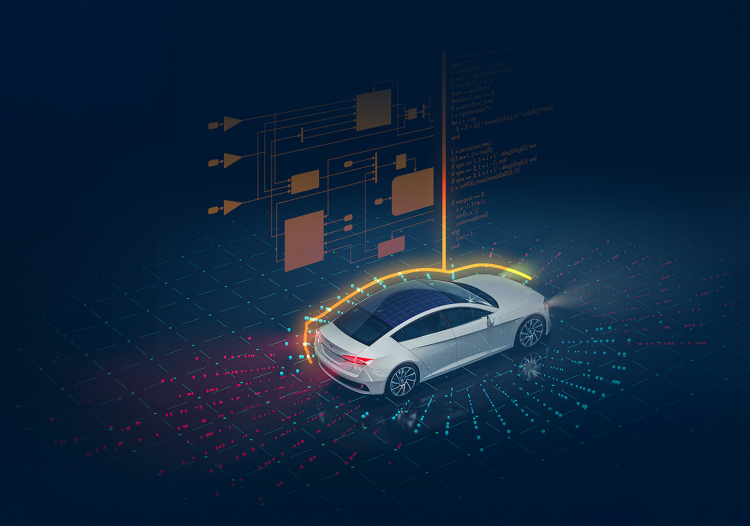
The MathWorks answer to the trust problem is Model-Based Design: a framework that uses executable system models as the consistent, deterministic backbone of the development process.
This gives engineers a structured method for validating AI-generated output, including the ability to catch algorithm issues before they reach production. The approach adds boundary conditions that make it possible to determine whether an AI is doing what it is expected to do or drifting into unreliable territory.
“Maybe you’re using generative AI to create an algorithm that will make decisions in your system,” Marchant said. “You take that generative AI-created algorithm, put it into the overall system model, then you run your simulation and review the simulation results: the signals and the system behaviour.”
Testing every scenario before anything is built
Running the virtual model across a range of scenarios lets engineers stress-test AI-generated algorithms in conditions they have not yet encountered in the real world, building confidence iteratively, before any physical implementation begins.
“You can give it a test run even before you’ve started to implement it. By doing that iteratively, you can start to gain confidence that the AI is not hallucinating,” Marchant said.
Traceability is the final piece. A consistent digital thread linking requirements, code and the purpose of the algorithm ensures engineers can always verify whether a system is performing as expected, and doing what is required.
“Generative AI and agentic AI are not something that we should be afraid of,” Marchant said. “This technology does hold the potential to help us as engineers, but we still need engineers to be making smart engineering decisions. We still need their engineering expertise to be able to formulate the deterministic processes that are required.”
To find out more about how engineers can better use AI, visit the Mathworks website.