
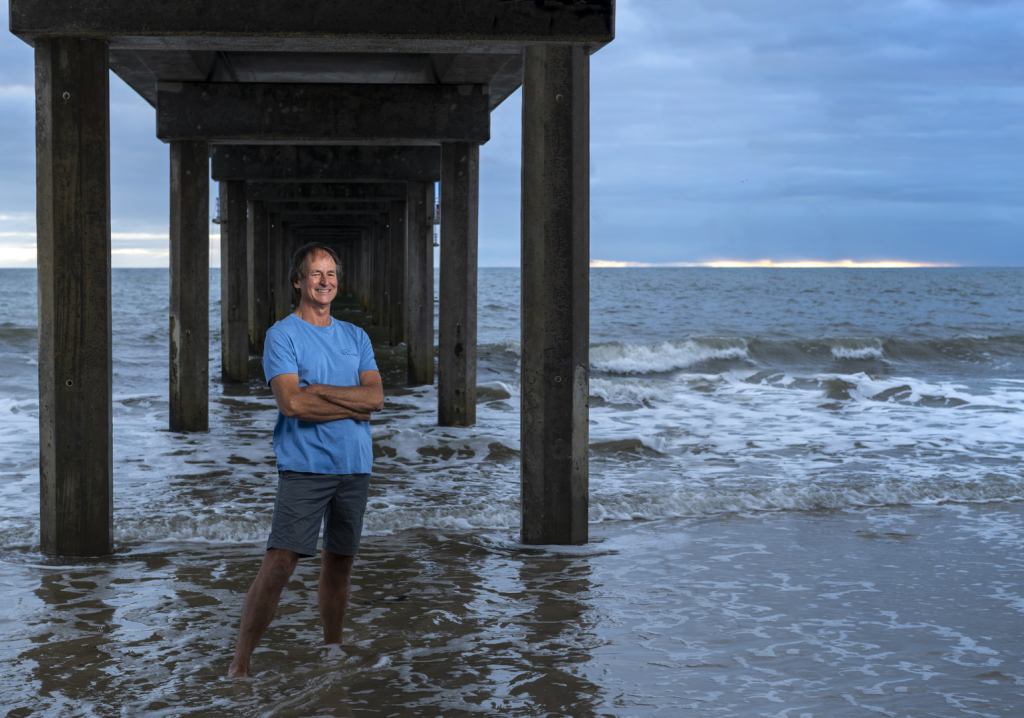
A career in tech gave electrical engineer Alan Noble the skills he needed to focus on his great passion: ocean conservation.
After 11 years as Head of Engineering at Google Australia, Alan Noble FIEAust was growing restless.
Previously a serial entrepreneur in Silicon Valley, the South Australian native was keen to once again build something from scratch.
“I also wanted to give back to Australia, although I wasn’t quite sure in what form,” he told create.
A conversation with a marine ecologist gave him direction. Since he was a child, Noble had loved the ocean; speaking to an expert in marine ecosystems made him realise he could use his skills to protect it, too.
“The ecologist told me: ‘The number-one problem we face in marine research is not having continuous monitoring of underwater ecosystems.’ That’s when the penny dropped.”
In 2017, Noble founded AusOcean, a non-profit dedicated to improving the health of Australia’s marine environment. Its first major innovation was a compact floating platform that powers underwater devices such as video cameras.
“Think of the platform as a power pack that enables researchers to operate underwater,” Noble said. “It has photovoltaic power and 5G connectivity, and it’s both low-cost and highly resilient.”
For researchers, the availability of portable, continuous power creates myriad opportunities, according to Noble.
“There’s an awful lot of information that you can extract from an underwater video feed: for example, you can use image processing to determine water clarity, without necessarily needing a turbidity sensor.”
The platforms can also be used to power underwater speakers that allow conservationists to perform what is known as acoustic enrichment.
“Early research on depleted tropical reefs has shown that playing the sounds of a healthy reef – shrimp snapping, for example – can accelerate the replenishment of a depleted reef threefold,” Noble said. “What might have otherwise taken 15 years can be accomplished in five.”
Settling down
Now 65, Noble describes himself as “very content” in his life and work in Australia. But for much of his career, returning home felt like a remote prospect.
After graduating from Adelaide University with a degree in electrical and electronic engineering, he moved to Japan, which he had previously visited on a high-school exchange, and fell into work translating technical documents.
Dabbling in computer-translation programming piqued his interest in software development, and he enrolled in a Master in science and AI at Stanford. From there, it was an easy step into Silicon Valley.
“I graduated in 1988, which was an exciting time to be in California. I lived and worked there quite happily for 16 years.”
In 1996, he co-founded NetMind, which pioneered internet change detection and notification (CDN), a capability that would eventually inform services such as Google Alerts. The company grew quickly, developing a consumer CDN service that large companies including Boeing also utilised.
NetMind was acquired in 2000, leaving Noble to find his next challenge. “If you’d asked me at the time whether I thought I would return to Australia, I probably would have said no,” he said.
But in the aftermath of 9/11, Noble and his Australian wife began to sense a shift in American society.
With two young children to consider, the couple decided to return to Australia, where they would be closer to their extended family.
It wasn’t an easy transition. He took a job at a startup but was dismayed by its dysfunction, and toyed with the idea of starting another company himself but wasn’t sure he would find funding.
“I was a little taken aback by the lack of maturity of the venture capital system in Australia,” he said.
Before long, though, Noble could feel the Australian innovation scene bubbling up. A clutch of ambitious founders launched companies, including Atlassian, and Google opened a headquarters in Sydney, tapping Noble for its top engineering job.
“Australia reached a point where the ecosystem had grown enough to allow talent to move around,” he said. “That’s part of what made Silicon Valley so vibrant: you could develop your career there without moving away. It’s something Australia lacked, and reaching the critical mass to make it possible has helped us immeasurably.”
Today, Noble encourages young Australian engineers to “find opportunities where they can stretch in different directions”, whether that means pursuing post-graduate studies overseas or working for a stint in a major Northern Hemisphere tech or engineering hub.
“The best thing about an international career is that you retain the networks you build and can activate them later, wherever you end up. That is part of what makes Australia’s innovation scene so vibrant today: we aren’t afraid to go exploring first.”
A longer version of this story, featuring four other technical leaders who have lived overseas, will appear in the November 2026 edition of create.
WEBINAR: Simulating the great barrier reef