

Major infrastructure projects rarely run on a single common data environment. Experts from ARKANCE and Utopia Digital explain how connecting platforms, implementing strong information management practices, is the key to single-source-of-truth for your projects.
On one major Australian rail project, several contractors spent around six months working from an out-of-date tunnel alignment. The problem only surfaced when data from across the project was finally brought together for clash coordination, revealing stations sitting about 30 m away from the tunnel they were meant to sit over.
The cause was simple: an updated alignment hadn’t been shared between systems.
“Fortunately, spades hadn’t hit the ground in these particular areas yet,” said Ryan Townsend, Co-Founder and Chief Executive Officer of Utopia Digital.
Speaking at a recent Engineers Australia webinar hosted with ARKANCE, Townsend said the biggest information challenge facing major infrastructure projects is “the lack of connected project data”.
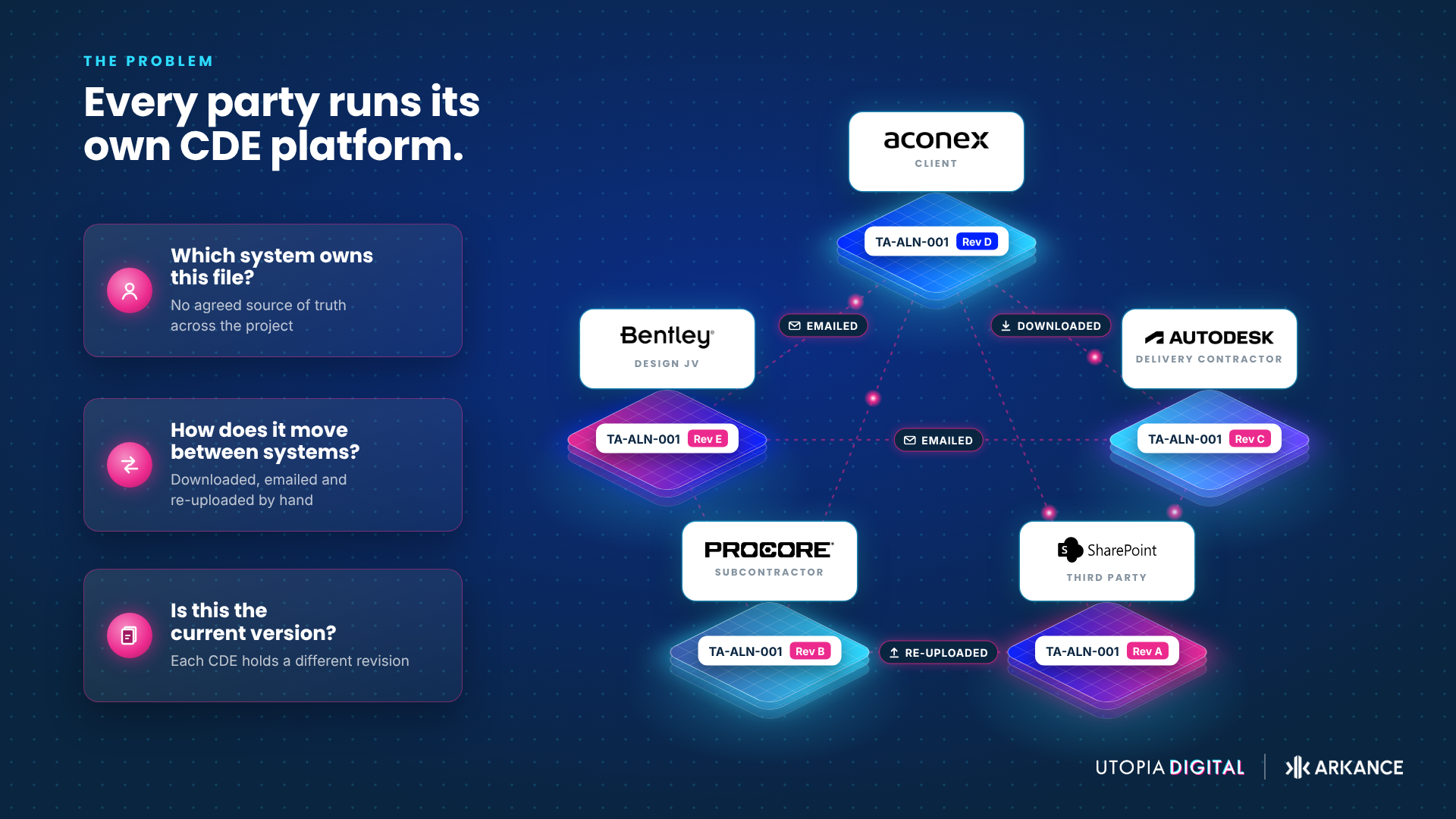
Large projects bring together multiple contractors and joint ventures, each with its own common data environment (CDE). ProjectWise, Aconex, Forma and SharePoint can all be in play at once.
“The fact that their systems are not connected and their data is not connected is a really big problem for project coordination,” he said.
One platform is not the answer
Trent Field, Lead Technical Consultant at ARKANCE ANZ, said multiple platforms are a reality of major projects, and not necessarily a bad one. Organisations have invested heavily in their systems, have contractual and security obligations and use authoring tools that integrate best with particular CDEs.
“For most of the large infrastructure projects or programs that I’ve seen, getting everyone into one platform is unrealistic,” he said.
The challenge is often not the number of platforms being used, but ensuring information is governed consistently across them. Without clear ownership, standards and information management practices, project teams can struggle to maintain trust in their data and documentation.
The problem, Field said, arises when it isn’t clear which system owns which information, how that information moves between systems and how people verify they are working on the current version.
The hidden cost of manual transfers
When files are moved by hand, those questions often go unanswered.Aaron Traylen, Co-Founder and Chief Operating Officer of Utopia Digital, said work built on the wrong version of information creates a chain of financial and legal risk – “dominoes falling”, as he put it. And if metadata is lost along the way, so is the ability to verify a document.
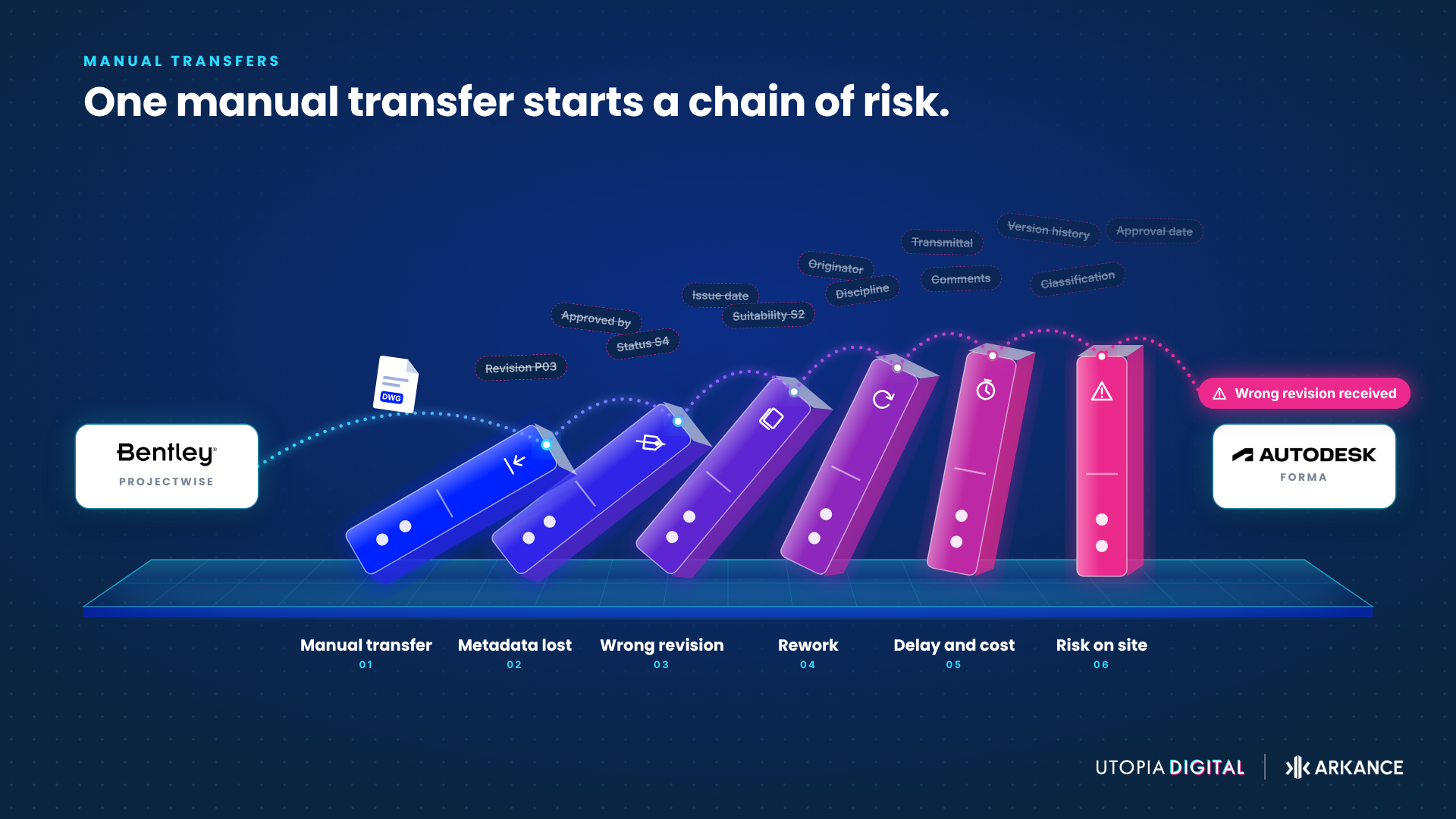
“The metadata acts as a verification mechanism, really telling us what it is, what it’s for, who’s approved it, what stage is it at in that life cycle,” he said.
That audit trail matters long after construction. Design decisions can carry legal implications for decades, so teams need to prove how information reached its current state, why it was issued and who approved it.
There is a human cost, too. Townsend described document controllers, engineers and BIM coordinators downloading files from one platform, re-uploading them to another and re-entering metadata in every system, adding up to tens of thousands of hours a year on large projects.
Field added that the consequences reach the site itself.
“There is an inherent safety risk to people on site as well,” he said.
Connected, governed and secure
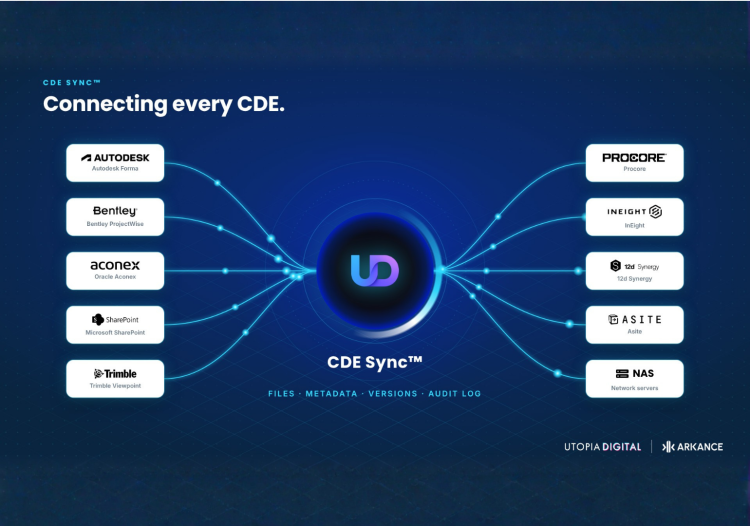
CDE Sync, developed by Utopia Digital and offered in Australia and New Zealand through ARKANCE, automates the synchronisation of files and metadata between platforms including Autodesk Forma, Oracle Aconex, Microsoft SharePoint, Procore, Asite and Bentley ProjectWise. It maps metadata across each platform’s different schema and records sync activity in audit logs, supporting ISO 19650 aligned workflows.
Traylen said the aim is to give clients a connected data environment without them taking on technical debt.
“They can wire things up and create one language for that information to flow between the systems,” he said.
Technology alone isn’t enough, however. Field said ISO 19650 information requirements should be set at the start of a project, while Traylen stressed that naming conventions and schemas evolve and must be governed across every system.
“It’s not just set and forget,” he said.
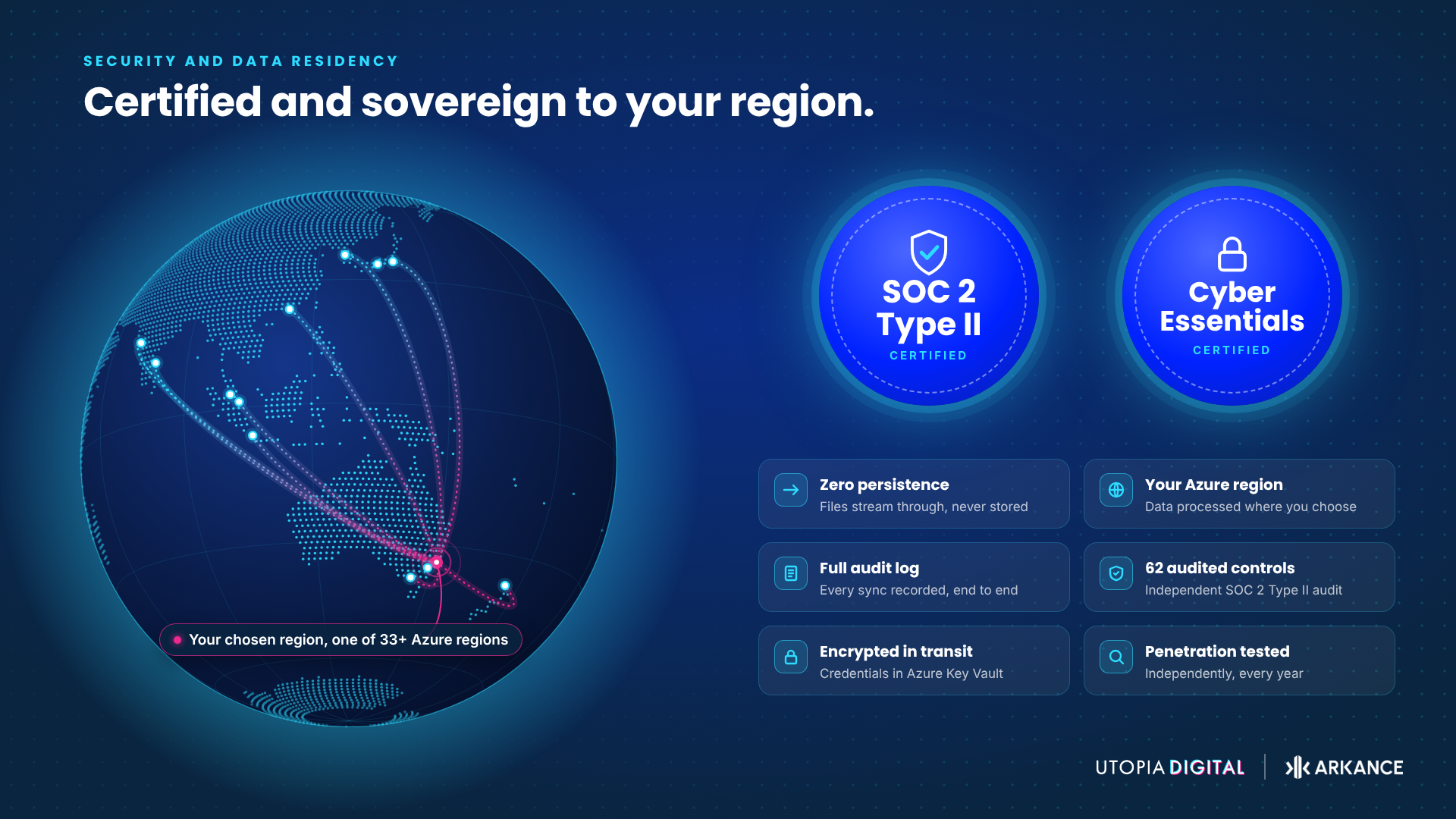
Security is the other half of the equation. CDE Sync is backed by SOC 2 Type II assurance, independent evidence that its security controls operate effectively over time. Townsend added that organisations increasingly need to hold their own copy of project data, “for insurance purposes, but more increasingly for cyber resilience purposes”.
Putting AI to work on project data
Imagine asking which revision of the tunnel alignment is current, who approved it and when, and getting the answer in seconds. On a project where that information is split across five separate CDEs, nobody can answer the question quickly, and neither can an AI tool.
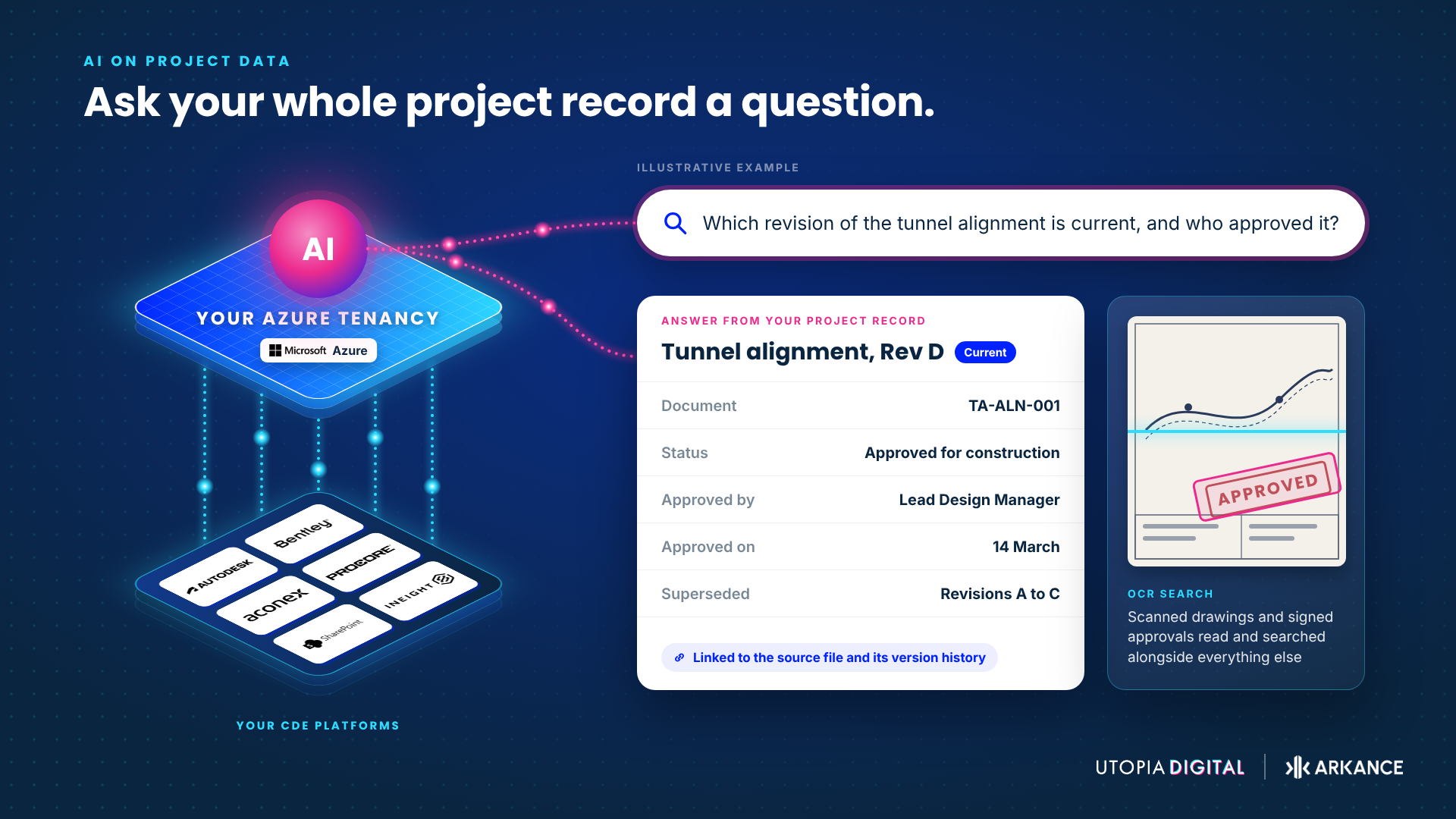
Townsend said connecting the data is what makes that kind of question answerable. When CDE Sync brings files and metadata from every platform into an environment the organisation controls, such as its own Microsoft Azure tenancy, the whole project record can be searched in one place. CDE Sync enables retrieval-augmented generation (RAG) AI so teams can ask questions in plain language and get answers drawn from their own project documents. Optical character recognition (OCR) brings scanned drawings, signed approvals and other image-based records into the same search.
The data stays in the client’s own tenancy, so the organisation decides who can access it and which region it is held in. The metadata that travels with each file gives the AI the context it needs to tell which version is current, who approved it and what stage it has reached in its life cycle.
Questions to ask before you connect
For teams assessing whether automated synchronisation could replace manual transfers, the panel’s advice points to several criteria:
- Is it clear which system owns which information and how it should flow between them?
- Are ISO 19650 information requirements, including naming, review and approval states, defined up front?
- Do metadata, version history and permissions travel with each file?
- Is there an auditable record of who issued and approved information, and when?
- Who will govern naming conventions and schemas as the project evolves?
- What independent security assurance backs the platform?
- Will synchronised data land in an environment you control, where it can be searched and analysed with AI?
For him, success means anyone on a project “can trust the information that they’ve got in front of them at any point in time”.
Watch the full Engineers Australia webinar, Better Decisions Through Connected Project Data, and find out more about CDE Sync from ARKANCE.