

How engineers are building a clock designed to keep accurate time for the next 10,000 years.
The Clock of the Long Now, developed by the Long Now Foundation and set to find its home in Van Horn, Texas, is one of the most ambitious long-term engineering projects ever attempted: a monumental mechanical clock engineered to survive millennia of wear.
While monuments can survive for thousands of years through passive endurance, clocks degrade over time due to their construction, energy systems and precision timing mechanisms – challenges at the heart of every engineering decision behind the clock.
The minds behind the clock
MIT-trained electrical engineer Danny Hillis developed the idea in 1995 to encourage people to think about the future. What started as a thought experiment has now been picked up by the Long Now Foundation.
The design has attracted figures such as Stewart Brand and Brian Eno, with the project overseen by Alexander Rose, who coined it as “the slowest computer in the world”.
A recent article in WIRED stated that the project, financially backed by Jeff Bezos, is set to scale to $57 million. Throughout the 10,000 year life span, the clock will be able to power itself, synchronise with the sun and generate a unique sequence of melodies, giving every visitor a different listening experience.
The chime generator will ring a series of 10 bells in a different arrangement each time.
The time is now
Foregrounding the project are five design principles: longevity, maintainability, transparency, evolvability and scalability. These form the conceptual framework for engineering a machine capable of operating physically over 10 millennia.
This time frame was selected because that’s approximately the length of time that human technology has existed.
- Longevity begins with materials science. The clock is constructed from titanium, marine-grade 316 stainless steel, ceramics, quartz and sapphire to resist corrosion, fatigue and environmental wear over millennia.
- The clock has been designed to require very little maintenance due to the implementation of bronze-age technology.
- To maintain transparency, the clock’s operation can be understood through direct observation, allowing future generations to inspect, interpret and maintain its mechanisms.
- The clock is built on an ethos of forward thinking, with features of modular infrastructure and separated functions so the system can evolve in response to changing environmental and societal conditions.
- The clock follows a scalable design, using proportional components and repeatable systems that allow the same model to be constructed from tabletop scale to monumental installations.
Eliminating failure points
Inside the mountain, the clock benefits from a naturally stable environment of around 13°, aimed at avoiding destructive freeze-thaw cycles and limiting thermal expansion stresses.
One concern is cold welding, a phenomenon where metal surfaces fuse together after extended contact. With some components of the clock moving so slowly they are essentially stationary, engineers needed to consider the impact on the metal parts.
The solution was material separation, where ceramic bearings are implemented throughout the mechanism due to their corrosion resistant properties and because they don’t bond together as metals can.
Another major problem is lubricants. Oils and greases eventually evaporate, oxidise or attract abrasive dust particles. The clock relies largely on dry mechanical systems operating at very low speeds with care.

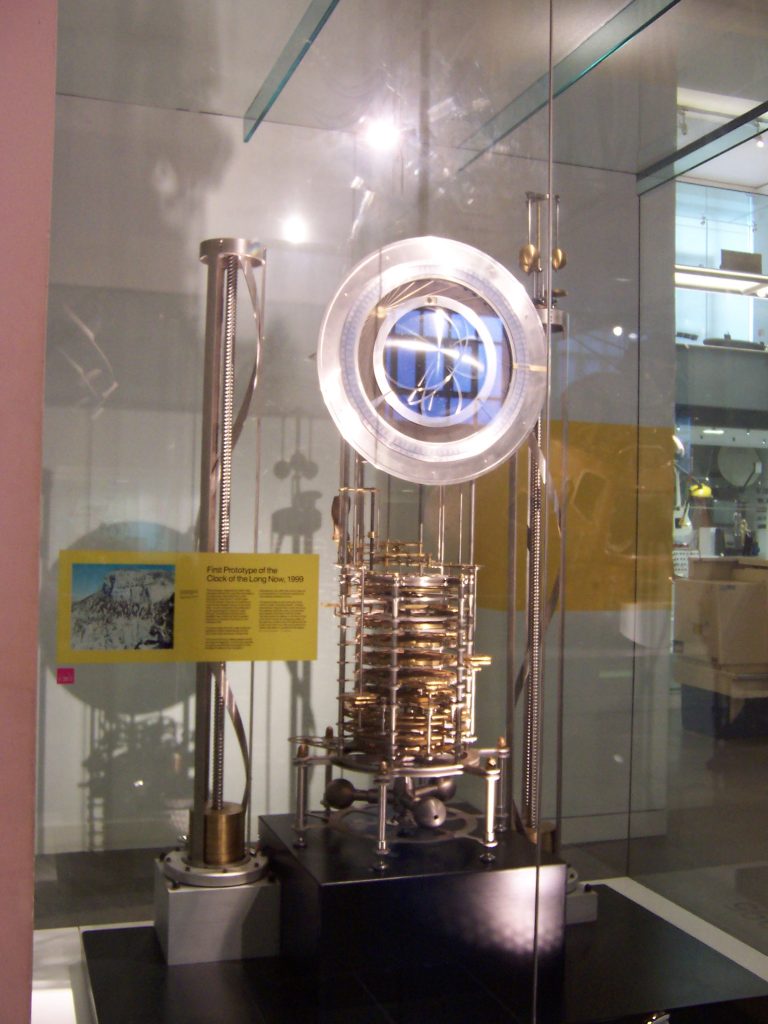
Rather than depending solely on electronic controls or automated monitoring systems, the clock uses passive processes. Despite its challenge inherent in achieving it, mechanical simplicity is essential. Every additional subsystem creates an opportunity for a failure point to arise.
To solve the issue of power generation across such an extended timeframe, the clock harvests thermal energy from sunlight which enters through an enclosed air chamber. This results in thermal expansion that moves a graphite cylinder and generates enough mechanical energy to keep the pendulum operating.
The system effectively combines thermodynamics, astronomy and precision mechanics into a single self-correcting timekeeping mechanism.
Remaining time accuracy poses probably the greatest challenge due to wear, environmental changes and microscopic variations in components. To overcome this, the clock periodically synchronises itself using the position of the sun.
Properties of the clock
Scaling hundreds of feet tall and is installed within a 150 m tunnel carved into solid limestone rock.
Despite its size, the clock follows the workings of a standard grandfather clock, apart from a few key differences. The clock has a base of 10 seconds so it will tick at one-tenth the speed of a regular clock.
And rather than having a 12-hour face, the clock will display the positions of the stars on a black globe.
The Equation of Time Cam is a key component that mechanically corrects the difference between solar time and clock time caused by earth’s elliptical orbit and long-term rotational variation.
Apart from timekeeping, the clock boasts other properties through what is known as mechanical computation.
Brian Eno has developed a chime generator that uses a cascading series of Geneva wheels to produce more than 3.5 million unique bell sequences – one for every day over the clock’s 10,000-year life span.
The Geneva wheel mechanism takes continuous rotation and converts it into intermittent movement, allowing the system to ring bells in changing combinations without electronics.
The clock includes mechanical astronomical displays and a Gregorian calendar system, which updates itself whenever visitors wind the mechanism.
Engineering for the future
Radical in its engineering approach, the maintainability of this clock is set to stand the test of time through its use of Bronze Age-level technology. Regardless of technological advancement, future generations should be able to inspect and repair the machine with the use of basic tools and observable mechanical principles.
The Clock of the Long Now operates at an unimaginable scale and asks what engineering looks like when the design horizon is strung out across thousands of years.
Its resilient materials, mechanisms and passive energy systems are designed to remain viable long after today’s technologies vanish.
Nominate an outstanding initiative for the Engineers Australia Project of the Year.