



The Future Road Competition is giving engineering students fresh ways to apply Safe System principles to existing infrastructure, along with practical experience and real-world knowledge.
Aakarsa Ramessur, a second-year RMIT mechatronics engineering student, has noticed an unexpected side effect from studying road safety – she can no longer simply drive through an intersection.
After modelling vehicle movements and collision paths with engineering software, she now finds herself mentally plotting the trajectories of surrounding vehicles.
“When I’m driving, my brain just automatically shows me if there’s a potential collision,” she said. “It has made me hyper-aware.”
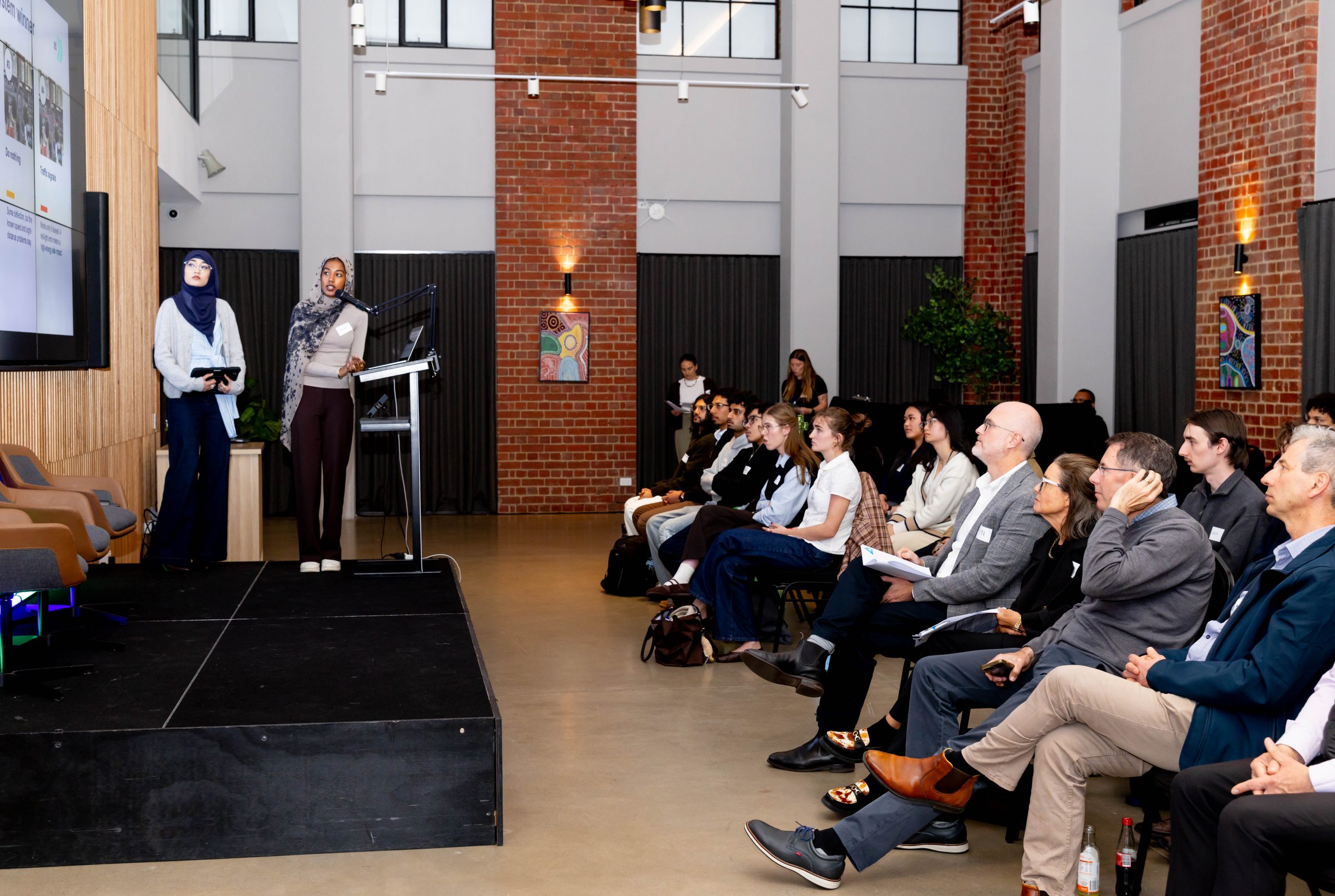
It is a by-product of Ramessur’s entry, with third-year civil engineering student Jasmine Ajra Khan StudIEAust, in the Transport Accident Commission (TAC) 2026 Future Road Competition.
The competition, now in its fourth year, tasks Victorian undergraduate engineering students with applying Safe System principles to a real-world road safety infrastructure project.
The Future Road Competition was developed after a 2018 national inquiry identified a gap in road-safety knowledge among recent engineering graduates. Teams draw on the Safe System for University (SS4U) Curriculum materials that are available to universities to include in their engineering courses.
This year’s challenge involved the Gilles and Timor streets roundabout in central Warrnambool, upgraded by the council earlier this year through the Safe Local Roads and Streets Program, a program delivered in partnership with the TAC and the Department of Transport and Planning.
Design with the assumption of human error
Most of the time people drive well, but sometimes they make mistakes. That is the premise of the Safe System approach, and of its principle that the design of the road system should do all it can to prevent those mistakes from resulting in death or injury.
“We don’t want to design a road first and then think, ‘Okay, we’d better make it safe now’,” said Associate Professor David Logan, Associate Director of the Monash University Accident Research Centre.
Instead, he said, safety must be designed into the infrastructure.
“In the past, we would design a road and then leave it up to the road user and the car designer to look after safety,” Logan said. “But the road system should be robust when people make mistakes.”
On a high-speed rural road, for example, that could involve barriers to prevent errant vehicles hitting trees or crossing onto the wrong side of the road, he said.
In urban areas, he added, it is more about protecting vulnerable road users such as pedestrians, cyclists and motorcyclists.
For Khan and Ramessur, whose team TriSafe Engineers won the 2026 competition, the Warrnambool site meant tackling visibility, vehicle speeds and inconsistent pedestrian priority at nearby intersections.
Their preferred solution was a raised roundabout with raised pedestrian crossings, lifting key parts of the intersection towards footpath level to improve visibility and use physical geometry to slow vehicles.
“There isn’t a sign asking drivers to slow down,” Khan said. “It’s more the shape of the road itself that does that for them.”
That distinction goes to the heart of Safe System thinking, Khan explained. A sign or signal relies on compliance; infrastructure can be designed for when compliance fails.

Kinetic energy = human consequence
The Safe System approach is built around the limits of the human body. Above about 30 km/h when a vehicle hits a pedestrian, 50 km/h in a side impact and 70 km/h head-on, the risk of death or serious injury rises sharply. Managing kinetic energy at those conflict points is the core design task.
Top selected teams in the 2026 Future Road Competition used Bentley’s MicroStation CAD software to explore how vehicle and pedestrian movements could translate into injury risk.
For Ramessur, it brought lecture concepts to life.
“We know what kinetic energy is in theory,” she said. “But we’ve not previously had it applied in real scenarios where you can see people being affected by it.”
There were trade-offs, too. The ramp profile, for example, would need to slow passenger vehicles without creating problems for an ambulance carrying a patient.
That practical dimension is what makes the competition valuable, Logan said.
“In university courses, there might be practical exercises, but you don’t really see how it will work in the real world,” he said.
A deep understanding of Safe System principles, Logan said, gives graduate engineers the ability to make “rational and logical arguments” in the real world.
Crying out for an engineered solution
Local roads make up about 85 per cent of Victoria’s roads, the TAC said, and around 40 per cent of serious injury claims to the TAC result from crashes on roads managed by local government.
The TAC and the Department of Transport and Planning’s $214 million Safe Local Roads and Streets Program is funding safety upgrades on these roads until mid-2027. Delivering them needs engineers, particularly in local government, who can apply Safe System design.
“The competition gives students the opportunity to apply the key principle of the Safe System approach: people make mistakes, so our roads need to be designed to minimise the chance those mistakes result in death or serious injury,” said John Matta, TAC Infrastructure Programs Director.
“It’s encouraging to see future engineers putting safety at the centre of their design thinking from the very beginning of their careers.”
Learn more about TAC’s road safety programs.