

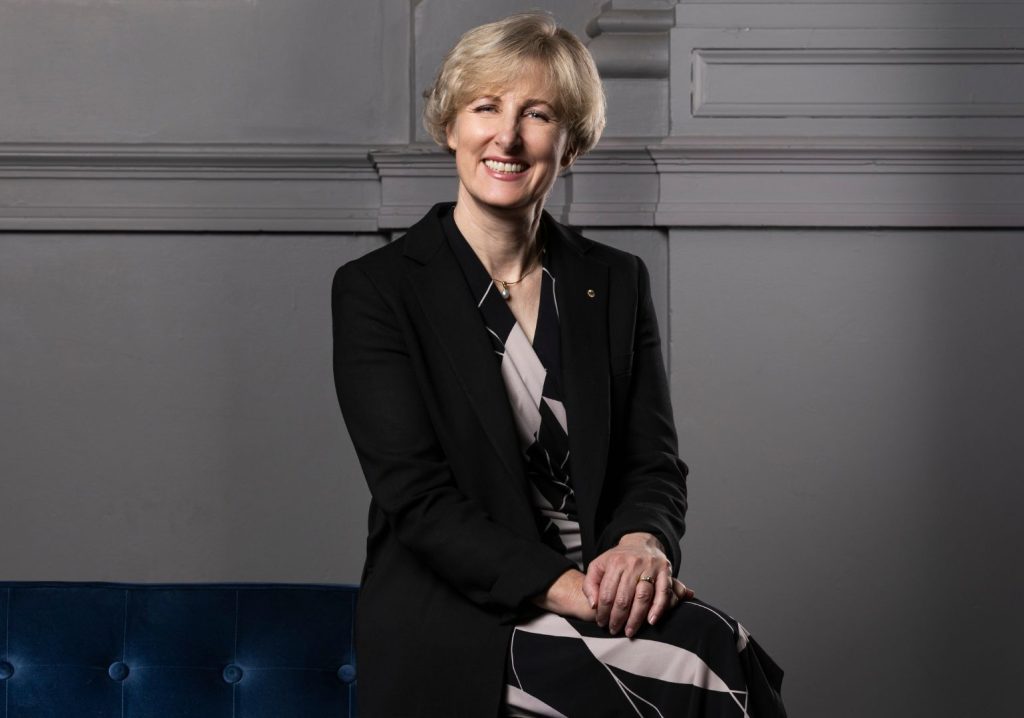
AUKUS, data centres, housing and energy are now competing for the same engineers. Engineers Australia Chief Engineer Katherine Richards AM HonFIEAust CPEng EngExec says the pipeline has to change, from turbocharging school maths uptake to introducing paid cadetships.
AUKUS was announced in 2021, and I’ve spent the past five years watching it take shape. What worries me most now about its successful rollout isn’t the technology or the money. It’s whether we’ll have the people to build and operate the program.
The Australian Government estimates the submarine program will create around 20,000 direct jobs over 30 years, from engineers and technicians to scientists and submariners. We have built much of the scaffolding: a submarine agency, an independent safety regulator, training pipelines, plus a skills academy and enabling works at Osborne, South Australia.
But the pace and scale are nowhere near what we need, because there’s a people problem.
The pool of workers who can do this work is tiny. They must work in classified environments and in the field of nuclear engineering, which draws on mechanical and electrical engineers and the trades that support them.
Migrants have long been the backbone of our engineering profession – about 60 per cent of the workforce – and they will stay essential. But we can’t rely solely on migration for this program. For security reasons, we need Australian citizens.
And while Australia has about 430,000 engineers, up to 70,000 are expected to retire over the next decade.
A rival no-one saw coming
AUKUS now also has a rival in digital infrastructure and AI. When the submarine program was announced, Anthropic was a brand-new start-up. The same year, SpaceX launched 31 rockets. Last year it launched 165.
This is what engineering capability looks like at scale.
CommBank counts more than 160 data centres currently in Australia, and estimates the build-out could reach about $150 billion by 2030. That’s roughly 40 per cent of the government’s 2023 estimate for the submarine program, which it put at $368 billion – in a fraction of the time.
AUKUS, data centres, housing, energy and the Brisbane Olympics and Paralympics now compete for the same engineers, electricians and welders. There’s no way near enough of them.
A good senior engineer can size up risk, make sense of a messy problem and get value from an asset, ethically and within the rules.
That judgement is a national security issue. This year an AI agent gained access to a Medicare statistics portal without authorisation, and the government only learned of it from the company months later.
AI can generate options, but it can’t replace human judgement. Engineers are the people who ask whether a system is safe, whether the risk is managed, and whether it can be trusted.
It starts in schools
This workforce crisis can’t be fixed at the top of the pipeline.
Our foundations in schools and universities aren’t strong enough. That isn’t a criticism of teachers; it’s about the settings we’ve given them. Too few students take maths and science, and too few reach the level engineering needs.
We must lift participation and performance together, which takes a change in culture – especially in Western Australia and South Australia, where performance is lowest.
When I visit schools, I meet students who love solving problems but have never considered engineering. What’s missing is visibility.
We’re also leaving talent on the table. Girls’ participation in advanced maths is falling. Australian-born women are fewer than 4 per cent of our qualified engineers, and women overall only 16 per cent.
Three-quarters of our female engineers were born overseas, so a program that needs citizens draws on a smaller pool.
Closing this gap is the fastest gain available to us.
The schools bucking the trend aren’t doing STEM confetti. They stick with a program for years, fund it properly and link it to industry, community and volunteers.
At Rutherford Technology High School near Newcastle, a Women in STEM program run with Orbispace and the Hunter Academy of STEM Excellence has lifted girls’ STEM enrolments from 13 to 90.
Orbispace, a charity for Year 8 girls, says more than 80 per cent of its participants go on to choose STEM electives.
Scaling that takes three things:
- Governments funding schools, because teacher cover and excursions always cost extra
- Engineers and industry experts volunteering as mentors
- Parents connecting their children to programs
READ: How to get more young people studying engineering
It continues at university
The same lesson applies at university.
In 2023 the government committed $128.5 million over four years for 4000 additional university places for the AUKUS workforce, which was welcome. But they were general STEM places, not tied to AUKUS, and funding places and hoping students flow doesn’t work.
We need volume: engineering places funded in perpetuity, students earmarked from the start, and tied to the work through cadetships.
Cadetships are earn-and-learn arrangements in which students are paid and give billable hours back to the company. They keep students out of poverty, give them a reason to stay and give employers better results.
Internships are usually unpaid and last 12 weeks – a chance to try before you buy. I want industry to offer more cadetships, and the government to help.
Since July 2025, the Commonwealth Prac Payment has supported eligible nursing, midwifery, teaching and social work students on placements, but engineering students – who must also complete practical placements – are excluded. Engineers need to eat too.
Our progress has been significant, but what got us here won’t get us there. The settings must change now: education, skills, migration and funding. Young people want work with meaning and impact, and AUKUS offers it.
I’m asking governments to fund, industry to hire, and engineers and parents to show up.