

To keep ahead of the technology curve, Australia needs maths-trained engineers. But too few young Australians are choosing to study it, threatening the future workforce.
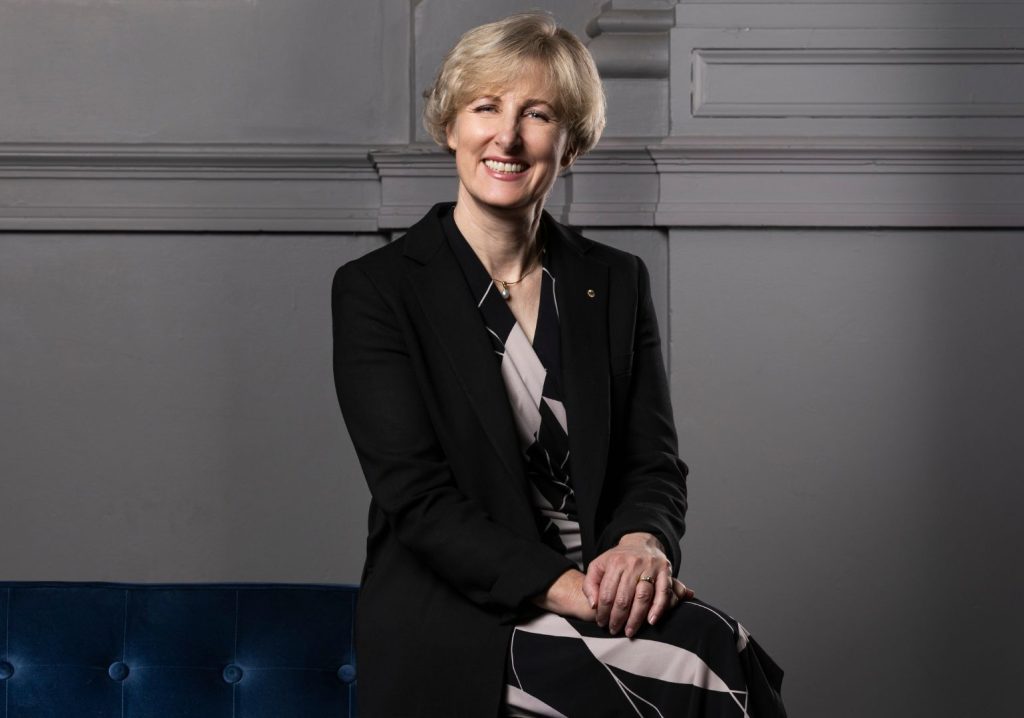
Katherine Richards AM HonFIEAust CPEng EngExec is Engineers Australia’s Chief Engineer.
It’s clear: there are shortages in every engineering discipline.
Around 70,000 Australian engineers are in the process of retiring, yet engineering enrolments and graduations have stayed largely static for more than a decade.
The only way the country can get out of this predicament is to improve its home game – and boost the number of children studying STEM and moving into engineering.
Engineers Australia is calling for the improved participation of all children in mathematics, in particular advanced mathematics, through to Year 12.
And we are calling for the decline in mathematics to be arrested with critical interventions by the government.
The recent Parliamentary Friends of Engineering roundtable identified ways the government can start targeting kids’ maths involvement – and maths confidence. In particular, potential policy actions such as:
- Direct assistance for maths teachers
- Reviewing and modernising the national maths curriculum
- Targets for students to stick with maths in higher education, particularly girls
- Prioritising funding of diverse pathways into STEM
READ: Australia has a maths problem that training more engineers can help fix
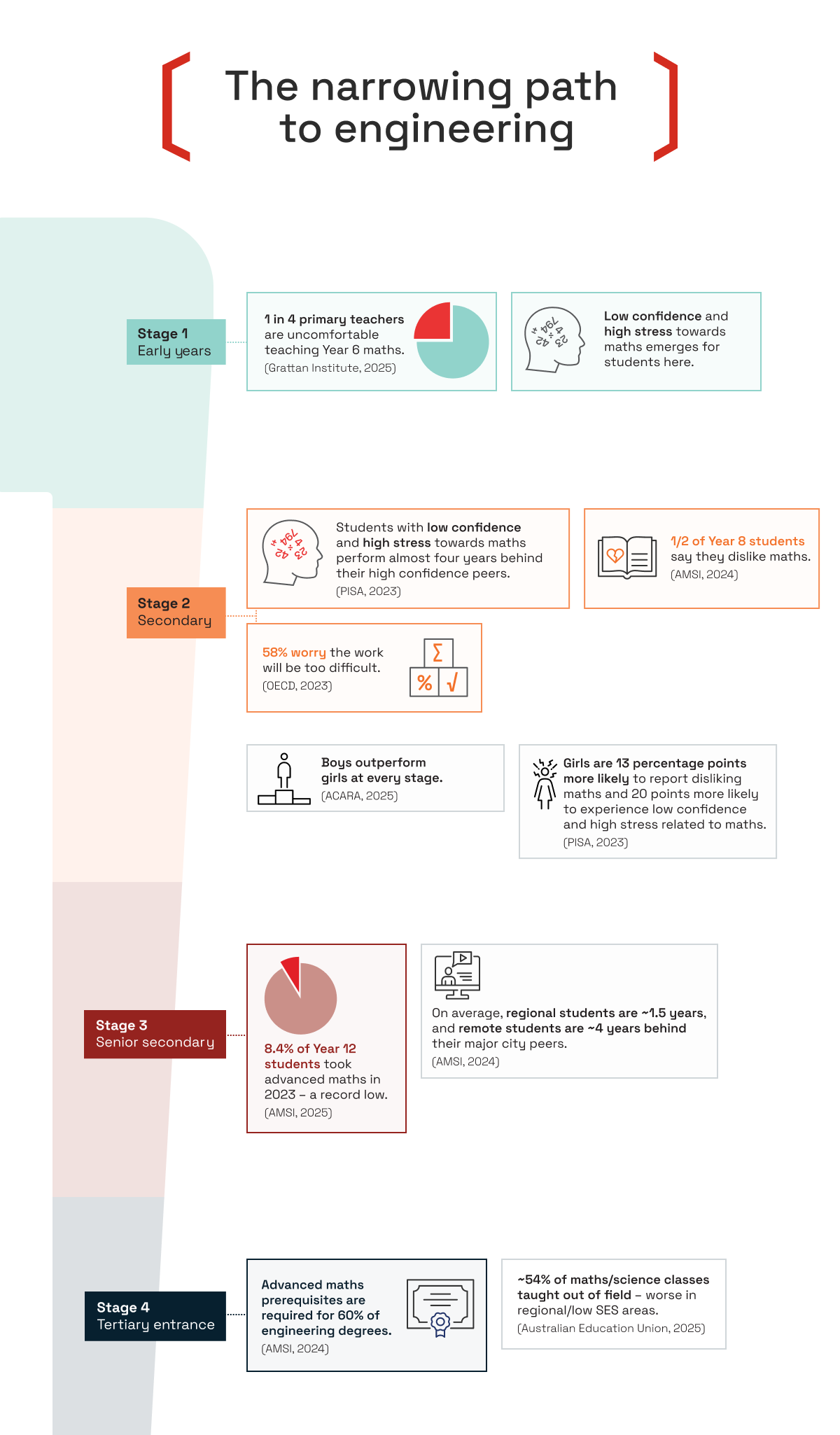
These are conversations worth having. We know there are persistent challenges in our education system, including lower outcomes for many boys in secondary school and lower participation by girls in advanced mathematics.
When it comes to STEM education, the golden rule is not to blame parents. We’re not going to blame teachers either. And we’re not going to blame governments. But we are going to communicate what needs to change.
The overarching message: you can’t get to engineering without maths.
Role models
As many as 40 per cent of maths teachers are working out of field. They work in other disciplines because the school says they need to. That needs to change.
Because a good teacher is an indispensable role model who helps kids unlock their potential to be confident in maths (and eventually become engineers).
It’s important for engineers to be visible. Never underestimate the extraordinary way kids connect with engineers at a personal level, when given the opportunity.
There aren’t any television shows about engineers. There are shows about doctors and lawyers, but not engineers. Kids need to understand the people behind the water industry, electricity network, AI, data centres, mining, agriculture and more.
It’s about sending a message that they don’t need to be brilliant at science, and they don’t need to be brilliant at maths. They just need to be competent.
Because one of the things that puts people off is the perception that only really smart people can become engineers.
Someone becomes competent by not being frightened of failure. So engineers need to have those critical conversations in classrooms and with the people in their lives wherever possible.
Dispel myths
The jobs of the future will always hinge on evolving technology. Technology disruption is real, and one of the ways someone can ride that process out is training their brain to manage and deal with new technology.
The other thing to remember is that engineers, regardless of their discipline, solve problems. This vital skill gives engineers purpose in life and in serving the community.
We don’t want our children to solely be users of technology. We want them to design, understand and master AI – to work alongside it and get the most out of it for the benefit of the community. The thing about maths is that it gives an insight into how AI works.
What a lot of people don’t realise is that AI derives its “intelligence” from calculus. That’s how AI gets “smart” – it does the rate of change.
The number one thing any engineer reading this can do is to share your story. Dispel the myths about engineering.
The most successful engineers are not necessarily the ones who can do a second order differential equation in their head. The most successful engineers are well-rounded people, truly solutions driven and well connected within their community..
Volunteer. Get the information out there. That’s how you can help to fix the problem of maths education and engineering enrolment.
Out of field
The University of Queensland’s Honorary Professor Merrilyn Goos is a mathematics education researcher and presented at the Parliamentary Friends of Engineering roundtable.
Australia needs to improve access to the most important resource in the education system: confident and well-prepared teachers. Nothing is more important than that.
Forget about upgrades to the school hall, laptops for every kid and all that stuff. That doesn’t make any difference – certainly not as much as teachers.
Schools assume that anyone can teach maths. Data (and that’s another problem we have – we don’t have decent data collection) tells us that somewhere between 30-40 per cent of teachers are teaching maths, but aren’t actually qualified maths teachers. They’re trained instead to teach another subject such as science, history or business.
Those teachers are out of field, which is a horrible term because it makes it seem like they’re lacking something. But there’s nothing wrong with these teachers. This is a wider, systemic problem.
Solving the issue of maths participation requires, I think, a system-level approach across three pillars:
- Comprehensive data collection processes to describe the teacher workforce. We don’t know how many qualified maths teachers there are in Australia. A first step is to record teacher specialisations as part of their registration process. At present, this only happens in NSW. This needs to be complemented by a data collection or data matching process to link teacher qualifications and experience to the subjects they are teaching.
- A nationally coordinated professional development framework, featuring a national program to upskill (re-specialise) out-of-field teachers of mathematics. The program should target the existing teacher workforce rather than waiting for new graduates, and it should prioritise locations and schools with the highest levels of need and student disadvantage.
- The National Strategy and Steering Group should coordinate stakeholder engagement across education jurisdictions.
This isn’t an impossible dream: I’ve had some experience with each of these three pillars when I worked at the University of Limerick in Ireland. I was director of a national upskilling program, fully funded by the Irish government, that has run since 2012 and has re-specialised more than 1600 formerly out-of-field teachers of mathematics.
Maths underpins so many professions, including engineering. But the way in which it underpins other professions is often invisible.