
Victoria’s Project of the Year has taken a novel nitrogen removal process, designed to save energy and carbon, from a pilot plant to full scale. It’s now bedding in.
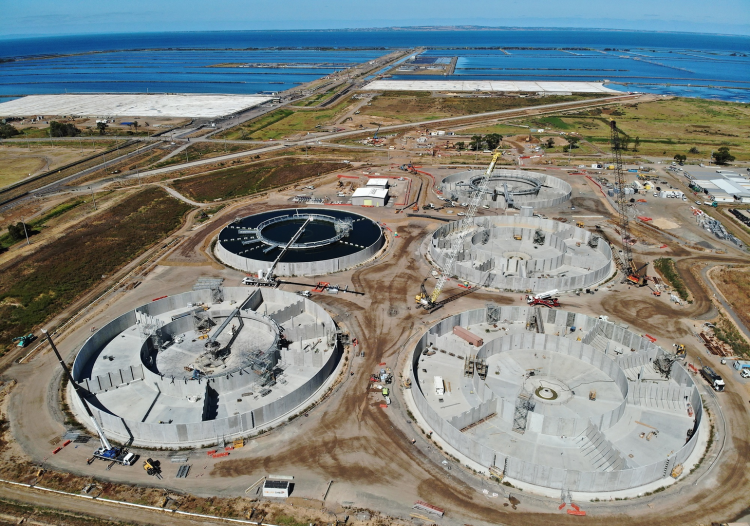
Melbourne’s Western Treatment Plant (WTP) at Werribee treats approximately 500 ML of wastewater a day, around half the city’s total. Its newest addition, the $330 million 5 West Nutrient Removal Plant (5W NRP), treats 150 ML/d, around 27 per cent of that flow.
Melbourne Water, designer Jacobs and contractor BMD started construction in 2022 and commissioned the plant in July 2025, completing a three-stage capacity upgrade plan for WTP that began in 2016.
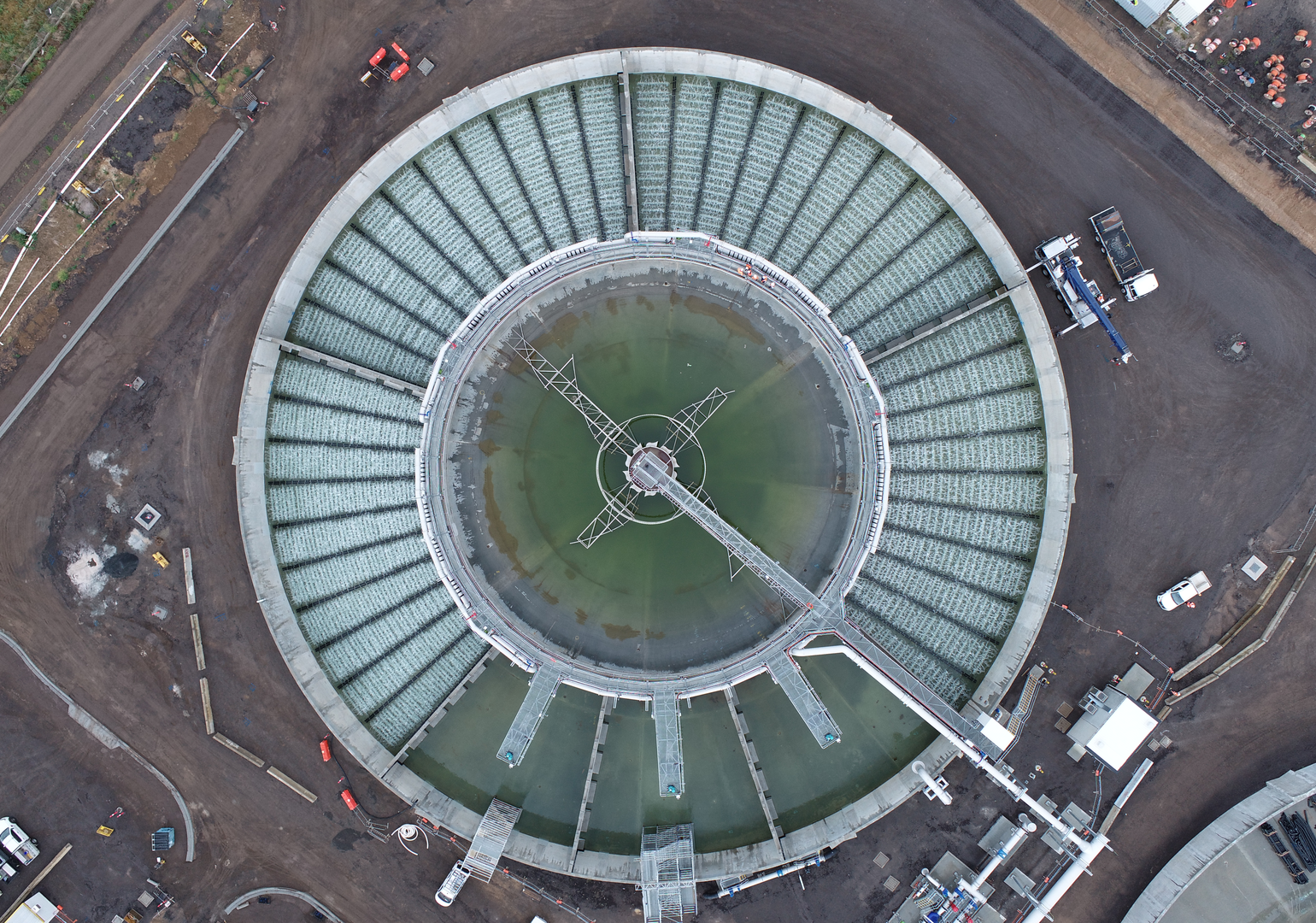
The plant comprises five huge circular tanks, each wider than a football field, which massively scales up a successful pilot shortcut nitrogen removal process via the nitrite shunt pathway trialled at WTP. The innovative process cuts several steps from the conventional nitrogen removal pathway, saving significant energy, improving effluent quality and providing a model for wastewater processing worldwide.
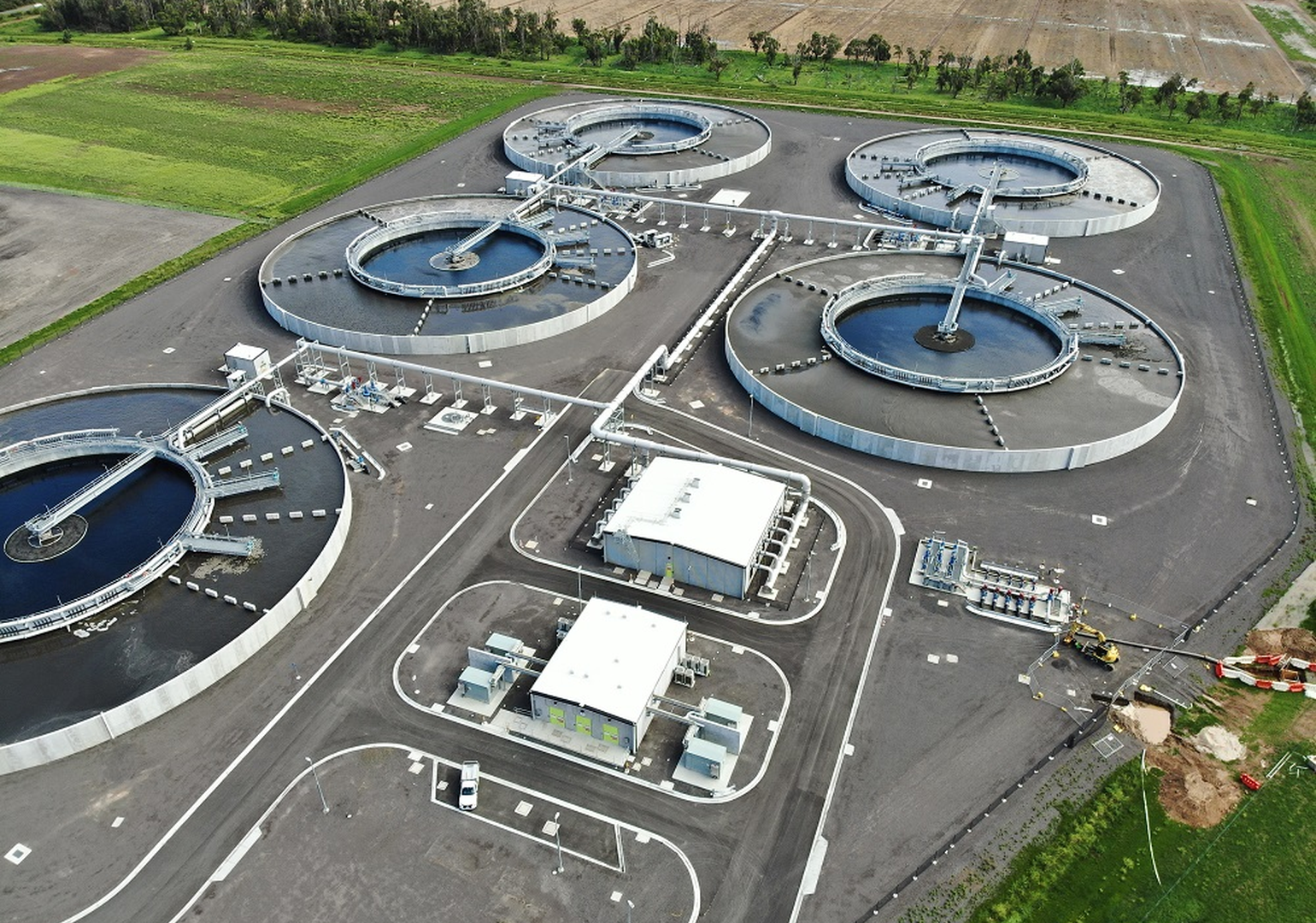
The 5W NRP replaces ageing infrastructure, providing capacity for future growth, improving overall plant efficiency and enhancing safety for operation and maintenance activities.
It has also been named Victoria’s Project of the Year at the 2026 Engineers Australia Excellence Awards.
Why Melbourne needed a different approach
In the early 2010s, Melbourne Water began planning for a growing city that was putting pressure on ageing infrastructure. The projected increased flows would lead to rising nitrogen loads that could exceed the Environment Protection Authority limit on discharges to Port Phillip Bay. Treating the sewage to meet the tighter nitrogen removal required with conventional processes would increase significantly the net energy demands on the site.
“Instead of trying to build more of the same, we asked ourselves: ‘How do we do things better?’” said Nathali Christy MIEAust, Melbourne Water’s WTP Process and Capital Lead.
Traditional wastewater treatment is inherently energy- and carbon-intensive. Melbourne Water identified – as part of planning for the future upgrade an emerging process – shortcut nitrogen removal via the nitrite shunt pathway, which materially reduces the oxygen and carbon demands for treatment compared with conventional processes. As at the time it was being investigated in the US and Europe and it had not been proven at scale, Melbourne Water developed a roadmap for implementation at WTP.
The shortcut process is particularly suited to WTP as it frees up carbon to generate more biogas from covered lagoons for greater energy recovery, while also reducing sludge volumes.
Taking the nitrite shortcut
Conventional nitrogen removal converts ammonia to nitrite, then nitrate, then back through nitrite to nitrogen gas. The nitrite shunt pathway skips the nitrate step. Christy said this theoretically saves 25 per cent of oxygen demand, reducing power usage associated with aerating the bioreactors and 40 per cent of carbon, which can instead be converted to biogas for electricity generation.
In aerobic environments, two key microbial groups drive traditional nitrification: ammonia-oxidising bacteria (AOB) convert ammonia into nitrite, which nitrite-oxidising bacteria (NOB) then transform into nitrate.
“We’re trying to inhibit the growth of the NOBs while maintaining the AOBs,” Christy said.
According to Aprilia Vellacott MIEAust CPEng, Technical Director of Wastewater for ANZ at Jacobs and the project’s lead process engineer, maintaining the inhibition of NOBs has proven difficult in overseas studies, particularly in the cooler temperatures observed in Melbourne.
“The real innovation is manipulating those conventional conditions to not grow this NOB bacteria,” she said.
Melbourne Water spent more than a decade progressing through the roadmap developed to implement this novel process, commencing with lab work and then building a 130 kL per day pilot plant, fed with the same sewage the full plant now takes.
Over two and a half years from 2017, the pilot plant demonstrated sustained reduction in the NOB:AOB activity ratio from the baseline of 0.98 to 0.26. Total nitrogen removal rose from approximately 60 to 86 per cent, and importantly the trial demonstrated the theoretical 40 per cent reduction in carbon required per kilogram of nitrogen removed.
Designing two plants in one
With no full-scale reference plant to follow, Jacobs designed the 5W NRP drawing on the key learnings of the pilot plant and significant process engineering development to provide a robust and flexible design.
The nitrite shunt process operates most efficiently on influent with a low ratio of chemical oxygen demand to total Kjeldahl nitrogen. However, because feed from the site’s covered anaerobic lagoons varies, the facility is equipped with full conventional aeration capacity as well. This flexible, dual-design approach ensures operational stability and acts as a dependable fallback if the full-scale nitrite shunt process proves challenging.
“We almost had to do two designs for the process,” Vellacott explained, “because there was potentially so much variation in the makeup of the inflow.”
The flexibility in the design, as well as the advanced controls to promote the inhibition of NOB, increases the complexity of the design and controls. That complexity came at a cost, Christy said. “With the advanced controls built in, we also have a lot more to optimise.”
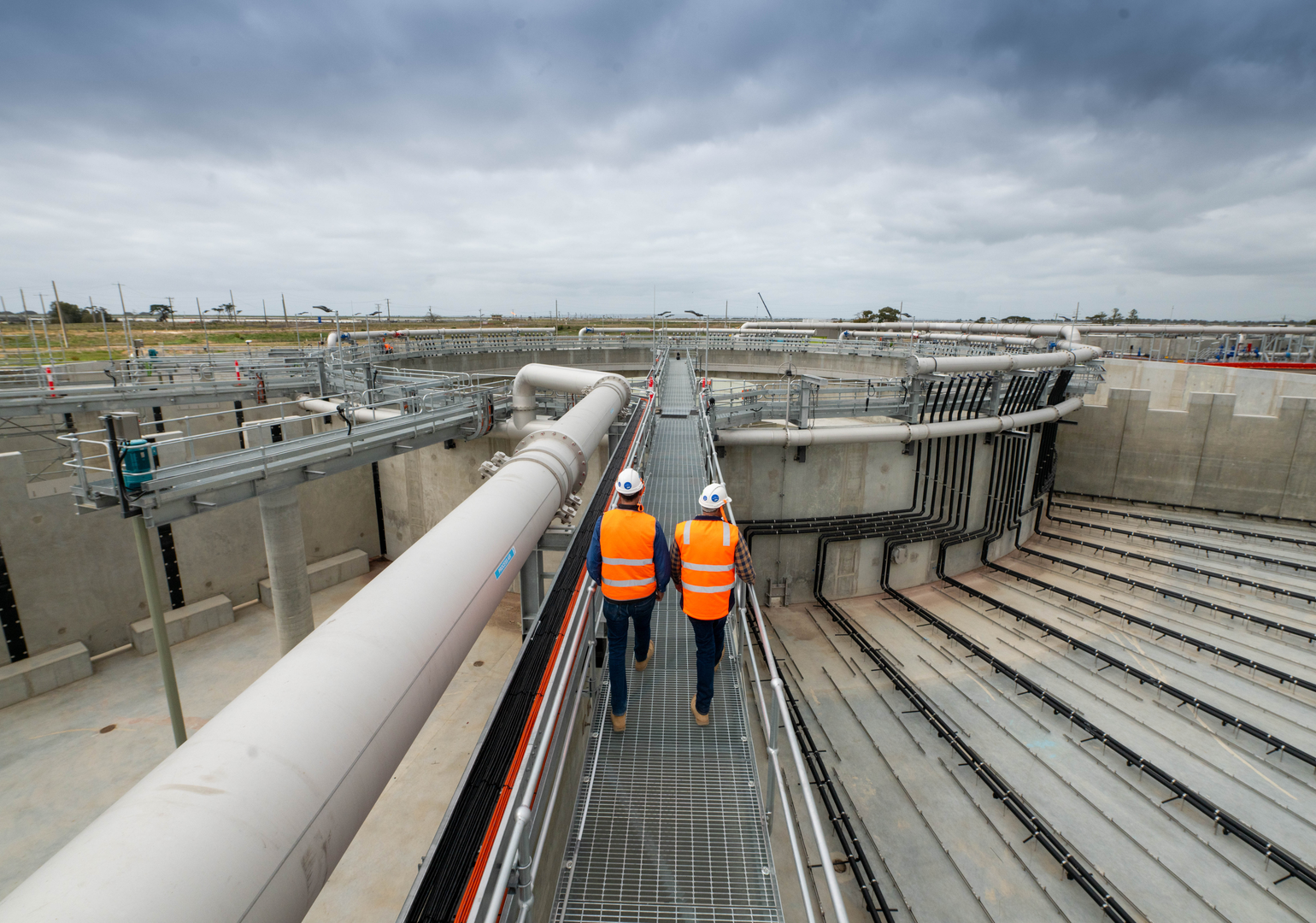
The full-scale plant consists of five circular tanks, each with an outer ring comprising of the bioreactor with a clarifier in the centre, with the two sharing an inner wall. Compared with the more typical rectangular reactor and separate clarifiers, the thin, precast, post-tensioned panels used about half the concrete and needed little formwork, decreasing concrete requirements by approximately 50 per cent reducing Scope 3 emissions from the plant’s construction.
Each bioreactor has four aeration zones that switch on and off – 20 across the entire plant – to create the right balance of aerobic and anoxic conditions. In a typical plant, zones are typically aerated or unaerated. The intermittent aeration increased the complexity of the aeration system design.
Planning for a shortcut
Led by Senior Project Manager Josh Kar, Melbourne Water chose to retain the process risk of deploying the emerging nitrite shunt process by selecting a design-then-construct model over a traditional design-and-construct contract.
Under this delivery framework, Jacobs delivered the detailed design, while BMD executed construction. To support this hands-on approach, Melbourne Water introduced an active client model, embedding a full client team, including a project manager, clerk of works, superintendent, safety advisor, and commercial personnel, onsite daily alongside BMD and Jacobs.
Commissioning was equally collaborative and delivered in staged phases: BMD led wet commissioning and initial process stabilisation, before handing over to Melbourne Water and Jacobs to drive final process optimisation and achieve shortcut nitrogen removal.
The biggest challenge in the eyes of BMD Project Director Trent Dunoon MIEAust CPEng was tying the new infrastructure into a live plant, which also included high-voltage energisation. His team ran more than 100 critical risk workshops with Melbourne Water’s operators.
In addition to the innovation in the process, BMD led the construction adopting a range of initiatives to improve the safety, environmental and social outcomes from the plant’s construction. For example, BMD imported a vacuum pipe lifter, allowing them to lay several kilometres of glass-reinforced plastic pipe without riggers or chains, eliminating safety risks from workers attaching pipe to the crane and nearly doubling productivity. Another innovation: instead of filling whole pipelines with water, BMD pressure-tested each joint, saving 4.25 ML.
“All five tanks were constructed and hydro tested and passed in their first go,” Dunoon said.
The project reached practical completion in June 2025, 46 days early.
Bedding in the biology
The result is a world-leading, utility-scale facility that lowers operational costs, delivers low-carbon biological treatment at scale and defers future drying pan expansions.
Providing more carbon to generate biogas increases the plant energy neutrality by approximately 80 per cent, Vellacott said.
While there’s been ongoing minor challenges in fine-tuning the complex process, the team presented early results at the WEFTEC 2025 conference in the US, showing NOB suppressed in four of the five bioreactors with NOB:AOB ratios below 0.5 and some near 0.2. Further operating results not yet published show NOB suppression maintained across all seasons. Some challenges with equipment have made control harder, but Vellacott said bedding in a new biological process takes time.
“It’s not only the innovation that’s so impressive; it’s the process of converting that theory into a working, full-scale plant,” Christy added.
Kar called it a brave decision for a public utility, to work through an extensive roadmap for more than 10 years to demonstrate an emerging technology in the unique conditions of WTP, and hopes learnings from the plant will change how the industry treats sewage.
TONIGHT: The winning Project of the Year will be announced as part of the 2026 Engineers Australia Excellence Awards.