CREATE
  • Technology
    • BIOTECH
    • COMMUNICATIONS
    • COMPUTING
    • IMAGING
    • MATERIALS
    • ROBOTICS
    • SOFTWARE
  • Industry
    • DEFENCE
    • INFRASTRUCTURE
    • INNOVATION
    • MANUFACTURING
    • POLICY
    • PROJECTS
    • TRANSPORT
  • Sustainability
    • ENERGY
    • ENVIRONMENT
    • RESOURCES
  • Community
    • CULTURE
    • PEOPLE
  • Career
    • EDUCATION
    • INSPIRATION
    • LEADERSHIP
    • TRENDS
  • About
    • CONTACT
    • SUBSCRIBE
No Result
View All Result
CREATE
No Result
View All Result
Home Technology Materials

We can mine the deep sea. Should we?

Chris Sheedy by Chris Sheedy
1 October 2026
in Materials, Features
Reading Time: 5 mins read
0
We can mine the deep sea. Should we?

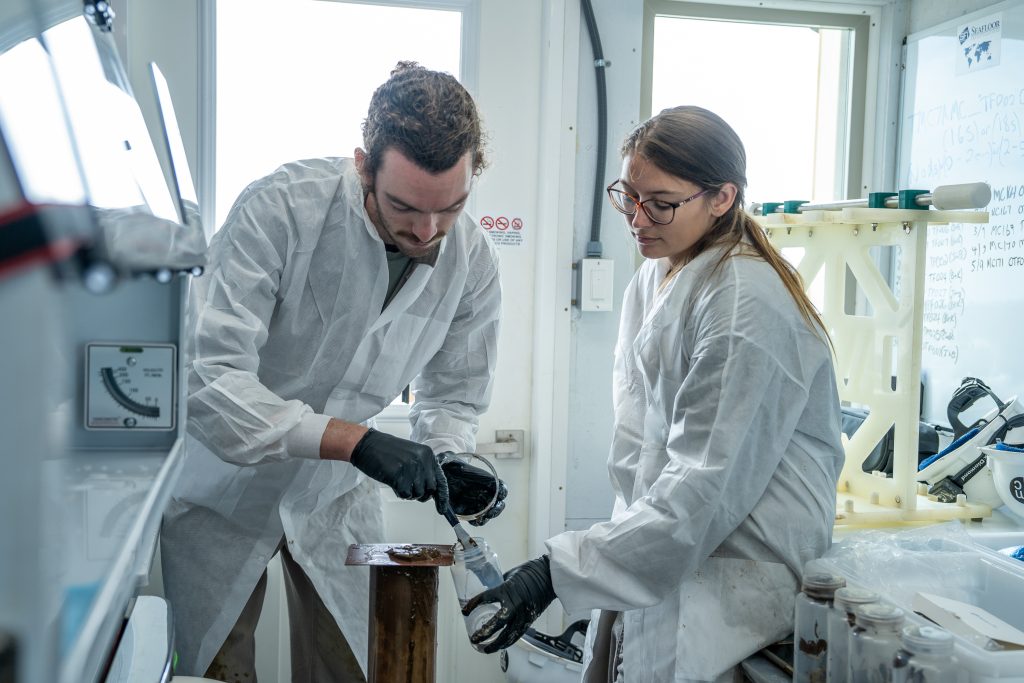
Civil engineer and environmental scientist Dr Jayden Hyman. Image: supplied

Deep-sea mining promises a wealth of minerals. The engineering know-how required to bring them to the surface is only a part of the challenge.

The next great mining frontier, one that could help to solve a number of challenges for the traditional, land-based resources sector, lies kilometres below the surface of the ocean.

One particular section known as the Clarion-Clipperton Zone (CCZ) is estimated to contain more nickel than all land-based reserves combined.

That is important, according to Dr Jayden Hyman, a civil engineer and environmental scientist currently working at the University of Queensland’s School of the Environment as a postdoctoral research fellow. Demand for nickel is set to explode over the coming decades, but half of the world’s land-based deposits are located within “the top 10 per cent most important areas of land on our planet for conserving biodiversity and carbon”, Hyman said.

Dr Jayden Hyman

Around the globe, and particularly in the CCZ, roughly placed between Hawaii and Mexico in the eastern and central Pacific Ocean, interest is fast growing in polymetallic nodules. These are dark, potato-sized lumps formed over millions of years on abyssal plains lying 3500-6500 m below the ocean’s surface.

The nodules contain valuable metals including manganese, nickel, copper and cobalt. They offer an enticing potential source of metals needed for batteries and electrification.

As a result, interest in their extraction has accelerated.

A geopolitical battle

Recent media reports have made much of a multi trillion-dollar battle currently playing out over the minerals that sit at the bottom of the ocean.

There has long been interest in deep-sea mining, Hyman said, so much so that the UN set up a global authority, the International Seabed Authority, to manage permits and ensure exclusion zones. The UN also developed the United Nations Convention of the Law of the Sea (UNCLOS). 

The United States has never been a party to UNCLOS.

The recent news pieces were partly a result of the USA’s attempted sidestepping of such international oversight via a 2025 Executive Order which, a paper by the Lowy Institute reported, “mandated the acceleration of granting permits for US entities operating in the US continental shelf and in the deep seabed area by invoking the largely dormant Deep Seabed Hard Mineral Resources Act (DSHMRA) of 1980.”
There are several challenges to deep-sea mining, Hyman said. They are technological, regulatory, environmental, geopolitical and commercial. The deep level of uncertainty around the sector is fundamental to the engineering challenge. 

The question is not whether mining of the seabed is possible – that has already been proven with a highly successful two-month, deepwater pilot collection test program by The Metals Company and Allseas. Instead, it is whether engineers and policymakers can adequately understand and control what happens when they do.

Deep-sea mining: A crash course

What is involved in deep-sea mining?

When it comes to the collection of polymetallic nodules, which sit exposed or partly embedded in soft sediment rather than requiring conventional drilling and blasting, the mining system involves a highly specialised subsea production line, Hyman said.

A collector vehicle that travels across the seabed on tank tracks gathers the nodules, at the same time disturbing sediment around them.

The collected materials are transported several kilometres up to the production vessel on the ocean surface via a five-kilometre long riser pipe that has air pumped into it from below, creating a subsea elevator system.

“There are still lots of questions around how we can set aside enough areas that are unmined and leave enough hard substrate behind to support recolonisation.”
Dr Jayden Hyman

“Some residual sediment is discharged through a discharge pipe, down about one to two kilometres,” Hyman said. “There is research going on to find out whether this should be returned closer to the ocean floor, to minimise impacts.”

Every part of the process contains its own engineering and environmental challenges. They include the operation and maintenance of machinery under enormous hydrostatic pressure, supplying and controlling power kilometres from the surface, navigating a vehicle where GPS is unavailable, maintaining a long riser system in ocean currents, monitoring operations with deep-sea submersibles and much more.

Hyman in the lab. Image: supplied

Hyman said the environmental consequences cannot be separated from the engineering. At the seabed, for example, the collectors disturb sediment, creating plumes.

“These plumes can affect filter feeding organisms,” he said. “There is a lot of science being carried out around how far sediment plumes travel, and recent studies have shown they’re actually a lot more contained than we thought.

“Also, on the sea floor we know there is direct disturbance of organisms in the mining track. Engineers are developing innovative technology to pick up nodules with less sea-floor disturbance. However, there are some studies showing organisms rely on some of the hard substrate these nodules provide. So there are still lots of questions around how we can set aside enough areas that are unmined and leave enough hard substrate behind to support recolonisation.”

Removing the resource means removing part of the ecosystem, one that has formed over millions of years. 

“On a human timescale, once you remove them, they’re not coming back.”

READ: The pros and cons of deep-sea mining

A better mining alternative?

Because it is new and innovative and therefore interesting, Hyman said, deep-sea mining is attracting a great deal of attention, particularly in terms of its environmental impacts.

“There’s this concept called the precautionary principle, which is essentially about taking early actions to reduce the potential for harm. And that is good. But there are supply chains and existing industries having serious impacts that tend to get a lot less attention because they’re hidden in plain sight.”

There is an argument that deep-sea mining could provide critical minerals with some advantages over terrestrial mining. Forests don’t need clearing and communities don’t need relocating, for example. There is no open-cut mine or waste-rock dump.

However, it cannot be assumed that this means deep-sea mining is environmentally preferable, Hyman said. On land and in the deep sea, approaches to mining and the ecosystems affected differ remarkably. At sea, there is an opportunity to set high standards before the industry has even started. 

If we are to engineer our way to a sustainable future, it is important that we innovate across both existing and future industries and look at the whole supply chain.

“We know we can mine the ocean floor,” Hyman said. “However, the central question is whether we know enough for it to be done responsibly.”

EVENT: 44th Hydrology and Water Resources Symposium

Tags: maritime engineeringdeep-sea mining
Previous Post

Think smaller: 5 tiny technologies making a big impact today

Next Post

Infographic: How crane designs have changed over time

Chris Sheedy

Chris Sheedy

Chris Sheedy is a professional writer whose work has taken him to the UK, USA, Europe and China. He has a fascination with big things - ideas, organisations, infrastructure, achievements, brands - and the people and processes required to make them a reality.

Related Posts

Building the museum that bridged past and present
Projects

Building the museum that bridged past and present

8 October 2026
Whiteboard to dashboard: A practical path to productivity in construction
Features

Whiteboard to dashboard: A practical path to productivity in construction

8 October 2026
Microplastics, major problems
Materials

Microplastics, major problems

8 October 2026
Next Post
Infographic: How crane designs have changed over time

Infographic: How crane designs have changed over time

Leave a Reply Cancel reply

Your email address will not be published. Required fields are marked *

create is brought to you by Engineers Australia, Australia's national body for engineers and the voice of more than 120,000 members. Backing today's problem-solvers so they can shape a better tomorrow.
  • ABOUT US
  • CONTACT US
  • SITEMAP
  • PRIVACY POLICY
  • TERMS
  • SUBSCRIBE

© 2024 Engineers Australia

No Result
View All Result
  • Technology
    • BIOTECH
    • COMMUNICATIONS
    • COMPUTING
    • IMAGING
    • MATERIALS
    • ROBOTICS
    • SOFTWARE
  • Industry
    • DEFENCE
    • INFRASTRUCTURE
    • INNOVATION
    • MANUFACTURING
    • POLICY
    • PROJECTS
    • TRANSPORT
  • Sustainability
    • ENERGY
    • ENVIRONMENT
    • RESOURCES
  • Community
    • CULTURE
    • PEOPLE
  • Career
    • EDUCATION
    • INSPIRATION
    • LEADERSHIP
    • TRENDS
  • About
    • CONTACT
    • SUBSCRIBE