
CREATE
  • Technology
    • BIOTECH
    • COMMUNICATIONS
    • COMPUTING
    • IMAGING
    • MATERIALS
    • ROBOTICS
    • SOFTWARE
  • Industry
    • DEFENCE
    • INFRASTRUCTURE
    • INNOVATION
    • MANUFACTURING
    • POLICY
    • PROJECTS
    • TRANSPORT
  • Sustainability
    • ENERGY
    • ENVIRONMENT
    • RESOURCES
  • Community
    • CULTURE
    • PEOPLE
  • Career
    • EDUCATION
    • INSPIRATION
    • LEADERSHIP
    • TRENDS
  • About
    • CONTACT
    • SUBSCRIBE
No Result
View All Result
CREATE
No Result
View All Result
Home Technology Materials

Bend and Stretch: 3D-printing and the new conductors

create by create
7 March 2018
in Materials
Reading Time: 2 mins read
0
Bend and Stretch: 3D-printing and the new conductors

A team of American engineers have developed a 3D-printable metal that can conduct electricity  but be flexible and stretchable, opening up a range of flexible electronic devices from computer screens to soft robots.

Yiğit Mengüç, assistant professor of mechanical engineering at Oregon State University (OSU), said they took galinstan, an alloy of gallium, indium and tin which is liquid at room temperature, and added nickel nanoparticles and oxidized gallium to thicken it into a paste with a consistency suitable for additive manufacturing. A key element of the process was using sonication – the energy of sound – to mix the particles into the liquid metal.

“The runny alloy was impossible to layer into tall structures,” said Mengüç. “With the paste-like texture, it can be layered while maintaining its capacity to flow, and to stretch inside of rubber tubes. We demonstrated the potential of our discovery by 3D printing a very stretchy two-layered circuit whose layers weave in and out of each other without touching.”

Gallium alloys are already being used as a conductive material in flexible electronics. They are inexpensive with low toxicity and good conductivity, plus they have a “self-healing” ability to attach back together at breakpoints.

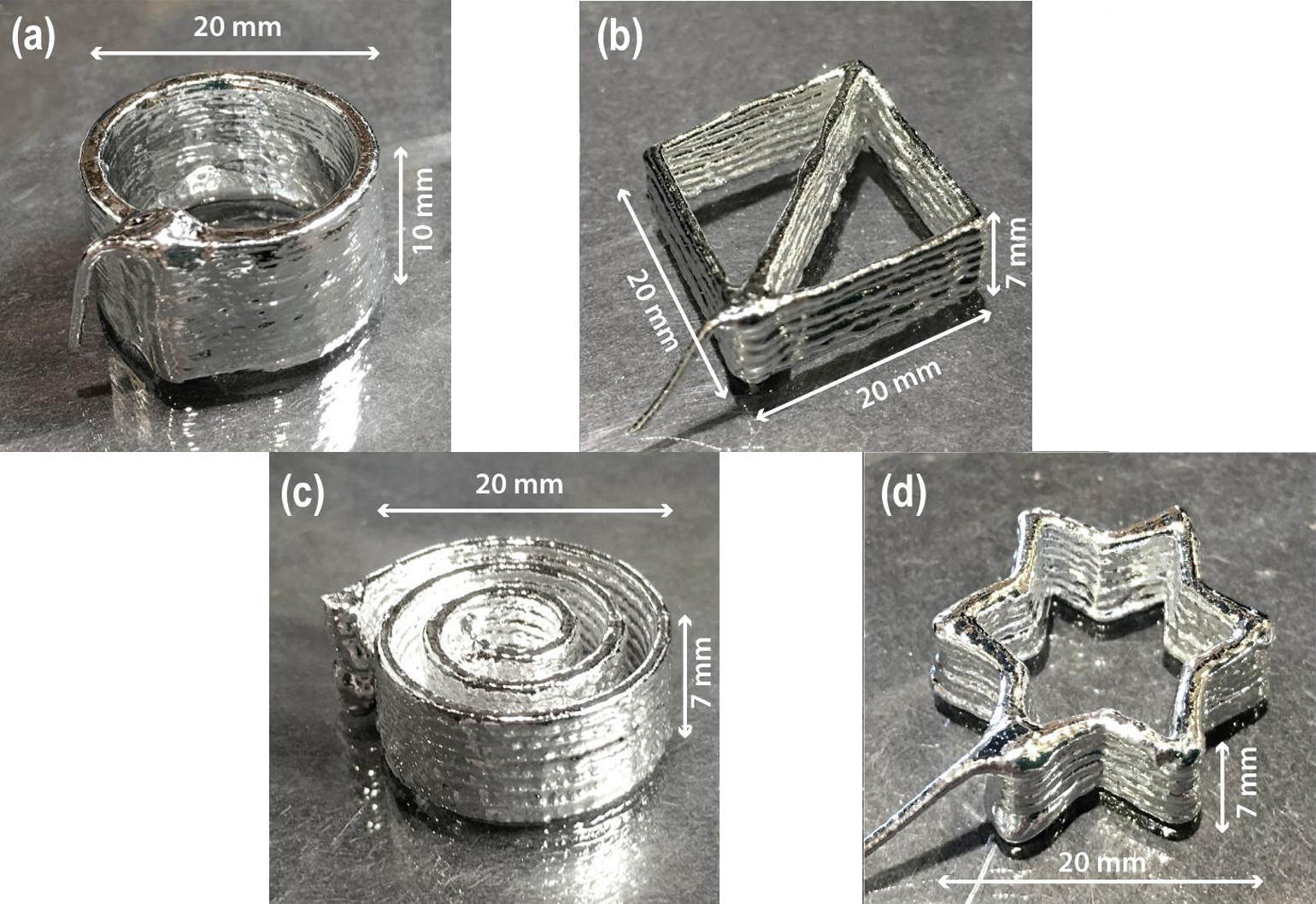
Prior to the OSU work, the printability of these gallium alloys was restricted to two dimensions. However, the team successfully printed structures up to 10 mm high and 20 mm wide.
3D printing Flexible electronics
Four structures 3D-printed with the flexible paste. Photos: OSU

The paste demonstrates several features new to the field of flexible electronics, said another team member, chemical engineer Uranbileg Daalkhaijav.

“It can be made easily and quickly,” she said. “The structural change is permanent, the electrical properties of the paste are comparable to pure liquid metal, and the paste retains self-healing characteristics.”

They say there is a broad range of products that could benefit from this development, including electrically conductive textiles; bendable displays; sensors for torque, pressure and other types of strain; wearable sensor suits, such as those used in the development of video games; antennae; and biomedical sensors.
 Future work will explore the exact structure of the paste, how the nickel particles are stabilised, and how the structure changes as the paste ages. 


Tags: 3D printing
Previous Post

Engineers Registration Bill in Victorian Parliament will increase public confidence

Next Post

Women engineers pressing for progress

create

create

create tells the stories behind the latest trends, innovations and people shaping the engineering profession. Through our magazine, website, enewsletters and social media, we spread the word about all the ways engineers help create the world around us.

Related Posts

Microplastics, major problems
Materials

Microplastics, major problems

8 October 2026
We can mine the deep sea. Should we?
Materials

We can mine the deep sea. Should we?

1 October 2026
Materials

This facility can process 160,000 t of contaminated soil annually

17 September 2026
Next Post
Bend and Stretch: 3D-printing and the new conductors

Women engineers pressing for progress

Leave a Reply Cancel reply

Your email address will not be published. Required fields are marked *

create is brought to you by Engineers Australia, Australia's national body for engineers and the voice of more than 120,000 members. Backing today's problem-solvers so they can shape a better tomorrow.
  • ABOUT US
  • CONTACT US
  • SITEMAP
  • PRIVACY POLICY
  • TERMS
  • SUBSCRIBE

© 2024 Engineers Australia

No Result
View All Result
  • Technology
    • BIOTECH
    • COMMUNICATIONS
    • COMPUTING
    • IMAGING
    • MATERIALS
    • ROBOTICS
    • SOFTWARE
  • Industry
    • DEFENCE
    • INFRASTRUCTURE
    • INNOVATION
    • MANUFACTURING
    • POLICY
    • PROJECTS
    • TRANSPORT
  • Sustainability
    • ENERGY
    • ENVIRONMENT
    • RESOURCES
  • Community
    • CULTURE
    • PEOPLE
  • Career
    • EDUCATION
    • INSPIRATION
    • LEADERSHIP
    • TRENDS
  • About
    • CONTACT
    • SUBSCRIBE