
When it comes to pioneering innovation, a programmable beetle and a clay-based cement supplement are just the tip of the engineering iceberg.
Technological innovations from engineers are achieving massive impacts. Here are just four of the latest engineering breakthroughs putting local innovation on the global map.
1. Cyborg beetle
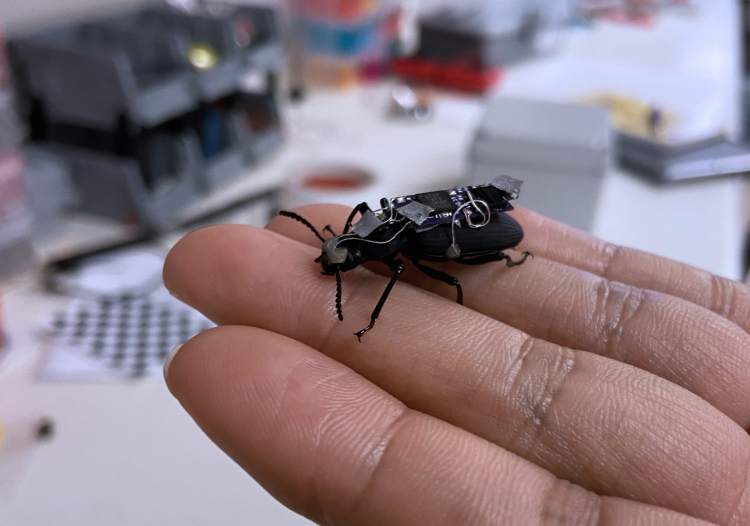
Darkling beetles have been fitted with microchip backpacks and controlled by engineers at the University of Queensland, without harming the insect.
The removable backpacks, developed by Dr Thang Vo-Doan and Lachlan Fitzgerald, are connected to video game controllers that are used to manoeuvre the beetles in specific directions. This is done using electrodes that stimulate the insect’s antenna or hardened forewings known as elytrons.
“Beetles possess many natural gifts that make them the masters of climbing and manoeuvring in small, complex spaces such as dense rubble, that are difficult for robots to navigate,” Vo-Doan said. “Our work harnesses these gifts and adds programmable controls that allow for precise directional guidance without affecting the lifespan of the beetle.”

The beetles are able to climb up vertical surfaces carrying a battery equal to its own body weight. This test involved a tethered power supply. Now, the engineers behind the research are looking to augment the packs with cameras and a more compact power system.
2. Dissolvable bone implants
A dilute zinc alloy manufactured by engineers at Monash University has nearly double the strength of biodegradable implants made of magnesium alloys, which the researchers say make it ideal for fabricating bone fixation implants.
The material boasts high mechanical strength but can also safely degrade over time as the body heals, said the Department of Materials Science and Engineering’s Professor Jian-feng Nie.
“An implant that never disappears will always be a risk to the patient,” Nie said. “On the other hand, one that degrades too fast won’t allow adequate time for the bones to heal. With our zinc alloy material, we can achieve the optimal balance between strength and controlled degradation of the implant to promote better healing.”

According to the study, “extruded [zinc] alloys of dilute compositions can achieve ultra-high strength and excellent durability when their micron-scale grain size is increased while maintaining a basal texture”.
By engineering the size and orientation of the material’s grains, the alloy could reform itself to adjust to the size and shape of neighbouring tissues.
“This made it not only stronger but more flexible, offering a game-changing alternative for orthopaedics,” Nie said.
3. Cement supplement
Stronger concrete may be possible with a clay-based substitute produced by mixing two different clays that are then heat-treated.
“This study [investigated] the potential of combining low-grade illite clays, characterized by low clay mineral content … and reactivity, with higher-grade kaolinite clays to enhance pozzolanic properties and mechanical performance in clay-cement blended cementitious mixes,” the RMIT researchers said in the journal abstract.
“An optimal clay mixing ratio of 1:1 was found to yield improved strength … and reactivity particularly when clays were co-calcined.”

The team was able to “replace 20 per cent of cement usage using low-grade illite and kaolin combinations, while achieving even better performance of the yield product”, Dr Chamila Gunasekara, Senior Lecturer at RMIT’s School of Engineering, said.
“Porosity is reduced significantly by 41 per cent, with its compressive strength increased by 15 per cent, where changes in the way iron compounds [are] formed help create a tighter and more compact internal structure.”
4. Bionic knee
A new bionic knee from MIT researchers has been designed to help people with above-the-knee amputations walk faster, climb stairs and avoid obstacles more easily than they could with a traditional prosthesis.
The new system is directly integrated with the user’s muscle and bone tissue, enabling greater stability and giving the user more control over the movement of the prosthesis.

An implanted titanium rod is placed into the residual femur bone where the leg has been amputated. A series of wires inside the implant convey information from electrodes placed on muscles. A robotic controller captures signals from the muscles and calculates the necessary torque to operate the prosthesis.
“All parts work together to better get information into and out of the body and better interface mechanically with the device,” Tony Shu, the study’s lead author, said. “We’re directly loading the skeleton, which is the part of the body that’s supposed to be loaded, as opposed to using sockets, which is uncomfortable and can lead to frequent skin infections.”