

Australia is aiming to reach net-zero carbon emissions by 2050, but the first real test of the nation’s climate responsibilities comes in just five years.
The country has legislated a 2030 emissions target of 43 per cent below 2005 levels, and sectors throughout the economy will need to decarbonise to ensure that aim can be met.
Akanksha Sharma, General Manager of Marketing and New Energy Landscape Lead at Schneider Electric, understands how critical transport will be in meeting these climate goals.
“For us to reach that 2050 target, we need 50 per cent of car sales by 2030 to be electric vehicles (EVs),” she said.
“Projections for 2025 show that, at the end of this year, about 11 per cent of total car sales will come from EVs. There’s a long way for us to go.”
That shortfall presents a challenge to Australia’s decarbonisation goals, but it also points to opportunities in the Australian EV landscape. One big opportunity, Sharma points out, lies in the nation’s electrical charging network.
“The shift to electric mobility is more than a technological upgrade; it’s a reimagining of how we power movement,” she said.
“As engineers, we’re not just building infrastructure; we’re shaping the systems that will define Australia’s energy and transport future.”

A growing network
The groundwork for that EV future is already being laid. Technologies such as batteries and vehicle-to-grid networks are growing more efficient.
At state and federal levels, governments are offering incentives and tax rebates to encourage everyday consumers to embrace EVs. Regulatory pressure, too, is spurring growth in the market.
And importantly, the practical uptake of the EV network is increasingly visible in Australia’s cities and along its highways.
In 2022, the country had 356 fast charging stations. This year, that number stands at 1100 stations with more than 3500 plugs nationwide.
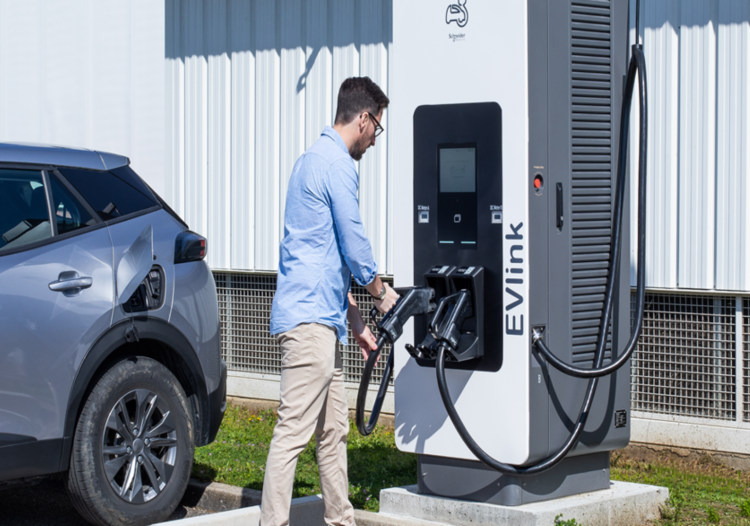
“Fast chargers are an essential part of electric vehicle charging infrastructure,” said Masha Ellis, Schneider’s New Energy Landscape Offer Manager.
“More and more EV owners have slow chargers at home, allowing them to charge their cars overnight or during the day using solar. But when you’re on the road, fast chargers are very critical because time and availability can significantly impact the overall journey.
“On the other hand, for a big fleet such as a transport network’s bus fleet, it’s important to have rotation so that they can charge as many vehicles as possible.”
While residential chargers tend to run off AC power in the range of 7 kW to 22 kW, and commercial operations, such as car parks and offices, use a blend of AC and DC chargers, the quick-hit, high-traffic demands of fast chargers draw on DC power, which ranges from 60 kW to 720 kW.
Sharma describes DC fast charging as a cornerstone of the EV transformation.
“Its true value lies in how we integrate it – intelligently, sustainably and at scale,” she said.
“This is our opportunity to lead with purpose, designing solutions that serve today’s needs and tomorrow’s ambitions.”

Yet simply rolling out EV charge stations is only part of the solution. The EV uptake comes with increasing energy demands, imposing strain on the electricity grid. Both hardware – installation and maintenance, for instance – and software solutions will be needed to help manage power demand.
“You can manage power consumption and charging behaviour locally before drawing from the grid,” Sharma said.
“Schneider offers a load management system as part of our portfolio, but there will be a blend of hardware and software solutions from a technology provider perspective. Schneider won’t be able to deploy all of this ourselves, so we rely on an ecosystem of partners.”
Ellis agrees that partnership is playing an important role in embedding and maintaining the necessary infrastructure.
“For example, at Schneider we have our own field service, but we also have a network of partners across Australia offering and commissioning our chargers,” she said.
“It’s important for energy companies to collaborate with us as the manufacturers of EV chargers so renewable energy can be integrated with smart grid solutions.”

Working together
The importance of partnerships within the EV charging landscape is clearly demonstrated by an initiative jointly supported by the Western Australian Local Government Association (WALGA), the Australian Renewable Energy Agency (ARENA), and the WA State government. This project brings together 22 local governments across the state to accelerate the transition to battery electric vehicles (BEVs) and install supporting infrastructure.
With a combined investment of $7.68 million from participating councils, the project will see the rollout of 129 BEVs to replace existing petrol and diesel fleet vehicles. To support this transition, 105 EV chargers are being installed across the participating regions. The infrastructure rollout is backed by $3.51 million in funding from ARENA and $1 million from the WA State Government, bringing the total project value to $12.26 million.
“It’s a strong example of how local organisations can collaborate with government incentives. With most of the chargers already installed, it’s shaping up to be a best-practice model for the rest of Australia.”
As a result, the state’s regional and remote councils have been able to overcome infrastructure and cost barriers, demonstrating the viability of aggregated procurement and standardised technology for public sector fleet electrification.
The rollout saw EV Charging Systems WA procured load management systems and 60 kW DC chargers from Schneider Electric to deploy to the network.
“It’s a great example of us leveraging our wider partner ecosystem to be able to work on this project together, which is a key area of focus for the WA government,” Sharma said.
Register for Schneider Electric’s Industry Partner Series webinar, Scaling EV infrastructure across Industries, to hear more on the latest advancements in DC fast charging for electric vehicles.