
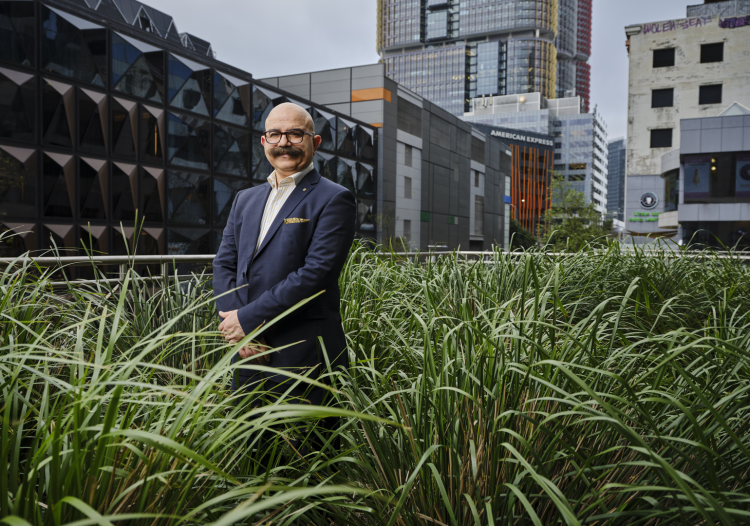
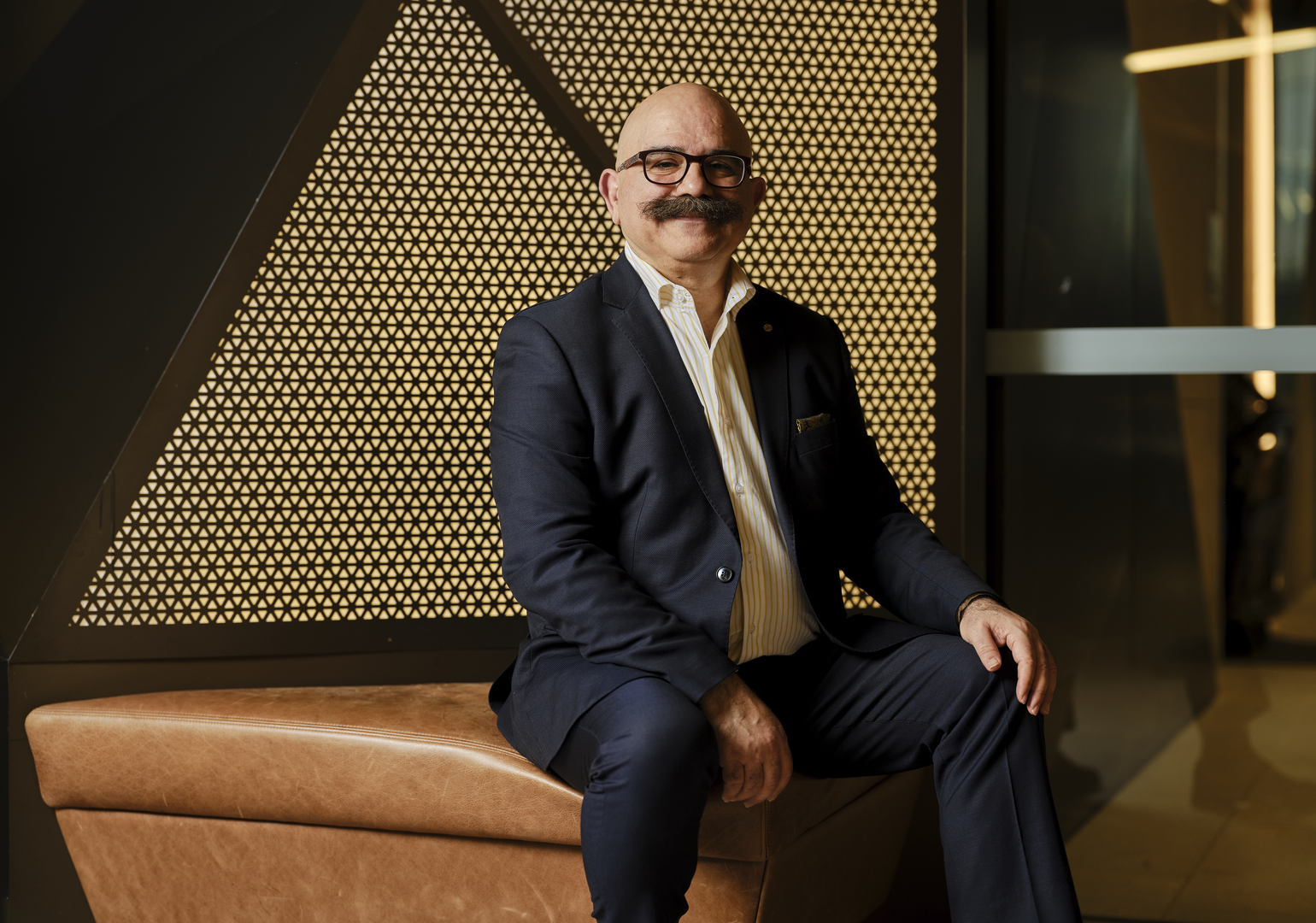
For civil engineer Kourosh Kayvani, remaining in Australia is a chance to support the country that gave him so much.
Dr Kourosh Kayvani FIEAust CPEng was determined to become an engineer long before he stepped foot on the University of Tehran campus in the late 1980s.
“Two of my uncles were civil engineers, and successful ones at that,” he told create. “They inspired me.”
In order to secure a place in the university’s engineering course, Kayvani knew he would need to devote himself to his secondary studies.
“Engineering, particularly back then, was a celebrated and revered degree in Iran, equivalent to medicine and above law,” he said. “It was extremely competitive.”
He worked hard and secured his place, completing a civil engineering degree in 1988. The course was comprehensive, but it had its shortcomings.
“It was theoretically deep, so it gave me a deeper grounding in the science and mathematical foundations of engineering than I would have received in Australia, but that came at the expense of practical aspects,” he said.
Kayvani contemplated postgraduate studies in the United States and Canada, receiving preliminary acceptances from MIT, Berkeley and McGill. But instead, he decided to take a chance on Australia, “a faraway place I knew very little about”.
Embarking on a Master’s degree at UNSW, he discovered his theoretical knowledge was more advanced than most of his peers’.
“As I was working my way through my Master’s, and then a PhD, I was curating my own curriculum by taking subjects in mathematics and mechanical engineering.”
His supervisors further broadened his skill set. “I really benefited from those people – my mentors – showing me how to be a good practising engineer, not just a theoretical one.”
Kayvani admits to a degree of culture shock as he entered the workforce as a full-time consulting engineer.
“Australian engineers were perhaps not the most polished or sophisticated in their interactions,” he said. “But they got things done. They got to the nub of the issue instead of skirting around it. They had an instinctive understanding of what mattered and they went to that, as opposed to being distracted by the peripheral aspects.”
Soon after he had completed his PhD, Kayvani decided he would stay in Australia and build his career here. He secured employment with international consultancy Aurecon, known at the time as Connell Wagner, where he developed a reputation as a problem-solver.
“I specialised in complex or difficult projects,” he said, “very tall buildings, very long span roofs, or structures that had previously failed.” He soon accumulated experience in finite element analysis, wind engineering, seismic design and fatigue assessment.
Collaborate, communicate
In the early 2000s, Kayvani achieved international recognition for leading the design of the arch of the new Wembley Stadium in London.
“Wembley Stadium presented the challenge of designing the slenderest and longest-spanning element ever attempted in a stadium structure. We had to deliver an iconic architectural form without compromising its structural safety. Being outside the scope of common codes of practice, we had to design the arch based on first principles of structural engineering.”
As a result of his work on Wembley Stadium and other complex and innovative structures globally, Kayvani was awarded the prestigious IABSE prize at the age of 39 and Engineers Australia’s John Connell Gold Medal a decade later.
In 2015, he took up a global leadership role at Aurecon, where he established Aurecon Design Academy, an industry-leading transdisciplinary education program for elite engineers.
Today, he is a Partner at global consultancy HKA, where he oversees the firm’s engineering expert-witness services internationally.
He has served as adjunct professor at major universities in Australia over the past two decades and also champions Australian engineering as a member of the Engineers Australia Board and Chair of the Australian Standards for Concrete Structures (AS3600).
“Both for myself and for other minority engineers that trained here before me, there was a sense of being embraced by Australia, and that made us feel indebted and eager to contribute to the fabric of engineering here,” he said.
Australia’s engineers have “consistently punched above their weight” in recent decades, he said, and the rough-and-ready attitude he encountered when he first moved here has evolved.
“Now, you’ve got to be able to collaborate. You’ve got to be able to communicate. The profession demands more of you, and gives you more, too.”
Despite working on numerous international projects and fielding regular offers of work in the Northern Hemisphere, Kourosh has remained in Sydney, where he lives with his family.
“It’s not just the work here,” he said. “I’ve travelled through five continents and seen a lot of places, and nothing matches the natural beauty of Sydney. Cape Town and Rio might come close, but nowhere has this beautiful harbour and bushland.”
Celebrate impressive individuals in Australian engineering by registering for the Excellence Awards Gala Dinner 2026.