

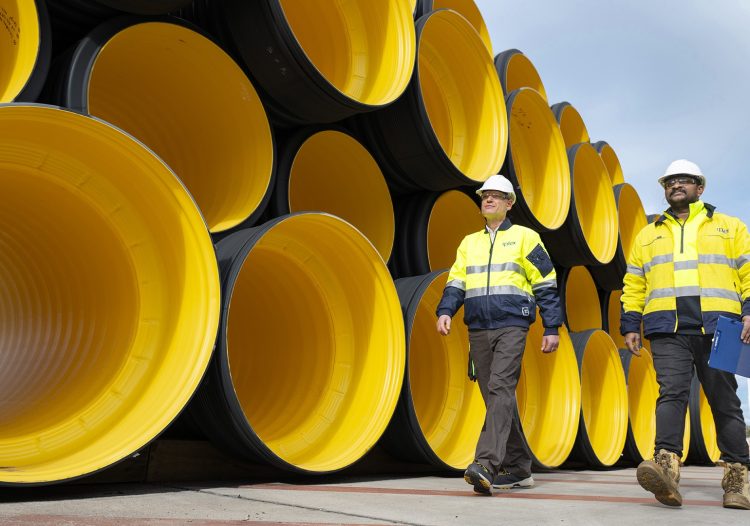

Faced with increasingly lengthy wait times for concrete stormwater pipes, a major Victorian development has put the easier-to-handle, lighter and flexible BlackMax through its paces.
Supply chain conditions at Stockland’s Harpley Estate in Werribee, Victoria, offered an opportunity to consider innovating around the long-established approach to stormwater drainage.
“The contractor wanted to use flexible buried pipes because of the long concrete lead times,” said Iplex Technical Sales Engineer Thomas Vu.
Jeff Tsiridis, Senior Project Manager with civil contractor Excell Gray Bruni (EGB), said concrete pipe lead times were ranging from 14 to 20 weeks because of the withdrawal of major manufacturers from Victoria.
“We were forced to consider what we think is a much better option.” He spoke.
In many Australian council areas, Iplex’s BlackMax structured-wall polypropylene pipe is an accepted stormwater option, but others still insist on the traditional concrete option.
This situation created the chance to test the product and prove to council engineers BlackMax’s suitability for purpose.
Same stormwater purpose, different structural behaviour.
Stages 57 and 58 of the Harpley Estate project called for around 1.5 km of stormwater pipeline, the majority of which is BlackMax, Vu said. Diameters ranged from DN225 to DN750.
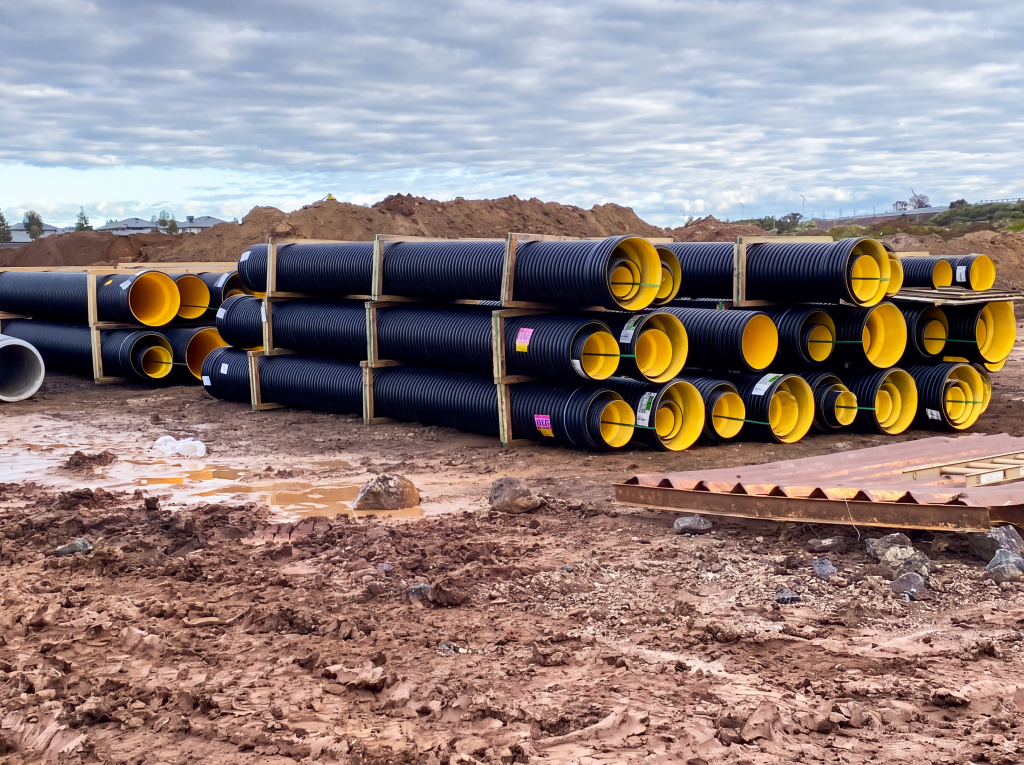
“With concrete, there are multiple classes of pipes,” Vu said. “Flexible pipe is just one pipe stiffness, relying on the support of the surrounding soil to accommodate the different depth of cover and loads.”
The pipe/aggregate/soil interaction, plus controlled deflection, creates the powerful stiffness of flexible pipes and enables capabilities previously only trusted to concrete.
To demonstrate BlackMax’s suitability on the Harpley project, Vu and Tsiridis took the existing design drawings and assessed longitudinal sections before modelling BlackMax.
“I used the same scenario that they designed in concrete and implemented BlackMax using our structural design tool, PocketEngineer,” Vu says.
That assessment took in factors such as backfill, depth of cover and expected loading, in accordance with relevant standards. The three principal parameters tested were buckling, vertical deflection and strain.
That analysis provided Wyndham City Council engineers with the information they required to assess the departure from the conventional concrete drainage solution.
Building confidence through design and installation
The pipe itself was only a part of the design discussion. The council engineers also insisted on cement-stabilised sand being placed around the pipe instead of the 7 mm aggregate.
The current trial also requires CCTV inspection of the pipes after 12 months, to offer council further evidence around the system’s performance.
Safer by design
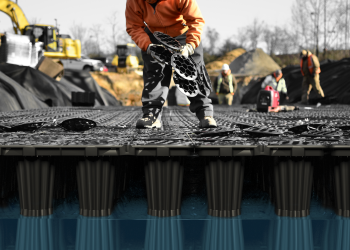
For EGB, one of the standout benefits was the reduction in manual handling and cutting risks compared with concrete pipe installation.
“BlackMax, in 6 m lengths as opposed to concrete’s 2 m lengths, is not just faster and easier to install”, Tsiridis said, “it is also a lot safer”.
Lifting, positioning, adjustment and cutting are all significantly simplified.
“From a safety perspective these are much safer to install in so many ways,” Tsiridis said. “When you cut a concrete pipe, there’s always an issue of people not knowing how to cut it the right way. People can find themselves in strife.”
EGB’s written assessment after the install described it as “a much safer process”.
Other positives they reported included:
- BlackMax pipe is significantly lighter than equivalent concrete pipe, making it much easier and safer for personnel to handle and position.
- The reduced weight reduces the reliance on heavy lifting equipment.
- Cutting BlackMax pipe is considerably safer and easier than cutting concrete.
- There is no requirement to place the pipe in a cradle, which further simplifies the installation process and reduces handling risks.
- The flexibility and lightweight nature of the pipe make positioning and adjustment easier during installation.
- We have had no issues with the pipe floating during installation, as the mix is dry.
Vu said beyond installation benefits, BlackMax delivers hydraulic advantages. Its smooth internal bore reduces friction losses compared with concrete, helping maintain flow performance across the life of the asset.
With three years still remaining on the Harpley Estate project, EGB has already recommended another BlackMax trial, this time using BlackMax with 7 mm aggregate to further reduce material costs, improve installation time and simplify backfilling.
For Tsiridis, the performance of BlackMax has already created a convincing case.
“It has performed very well and I prefer it 100% over concrete pipes,” he said.
The success at Harpley comes as Iplex prepares to launch BlackMax+, the next evolution of the system. Retaining the installation and handling benefits of standard BlackMax, BlackMax+ delivers double the pipe stiffness, providing engineers, councils and contractors with even greater confidence in shallow-cover, under-road and other demanding applications. Together, BlackMax and BlackMax+ offer a broader range of solutions designed to improve safety, installation efficiency and long-term performance across stormwater projects.
To learn more about BlackMax visit our website: www.iplex.com.au


Have the long-term impacts of this product been considered:
https://createdigital.org.au/microplastics-major-problems-standards/