
EarthSure in Melbourne is producing useful construction material by processing soil polluted with a range of dangerous contaminants, including forever chemicals.
In 2023, the Victorian government laid out its predictions for how the coming decades would shape a state very much on the grow. The resulting report, Victoria in Future 2023, anticipated a boom in the state’s population from 6.8 million to 10.3 million. Metropolitan Melbourne is to grow to eight million residents, and the state as a whole will need 1.6 million additional dwellings.
To accommodate the growth, Infrastructure Victoria recommends 45 projects and policies to ensure the state delivers access to housing, jobs, services and opportunities, at a cost of $65-75 billion.
That means a lot of construction activity, and part of that activity involves breaking ground – literally. The problem with that is digging up the dirt, and getting these projects on track often means disturbing earth that has absorbed a host of pollutants harmful to humans and the broader environment.
Each year, Victoria disinters hundreds of thousands of tonnes of contaminated soil: dirt rendered toxic and seemingly useless thanks to the presence of lead and other heavy metals, hydrocarbons, historic mining waste, asbestos, old pesticides and per- and polyfluoroalkyl substances (PFAS), among other unpleasant substances.
“Historically, contaminated soils of this type would be sent to landfill,” explained Mark Globan, General Manager for Resource Recovery at Veolia Australia and New Zealand.
The problem for the organisations handling contaminated soil is that the Environment Protection Authority (EPA) Victoria imposes duties for managing, transporting, depositing and receiving this waste material.
Depending on landfill sites to take the contaminated soil produced by a project can add significantly to its cost. Any budget-minded business should be hoping for a better way.
Washing and baking
Enter the EarthSure facility. A joint venture between Veolia, which has operational control, and the remediation services of Ventia, EarthSure can process 160,000 t of contaminated soil annually – a quantity that comprises, according to Globan’s estimate, 25-30 per cent of all contaminated soils generated in Victoria each year.
Located at Dandenong South, the EarthSure facility combines a thermal desorption plant, which has operated since 2018, with a brand-new soil-washing facility, which opened in 2025.
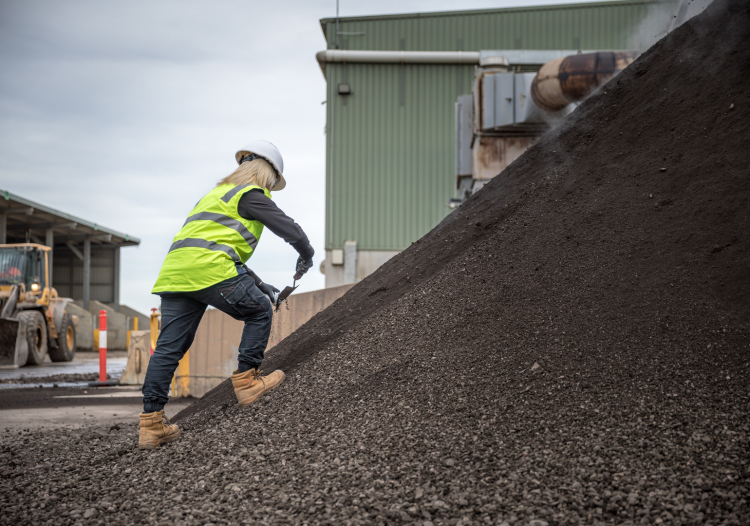
The $15 million soil-washing component, in particular, is an important part of EarthSure’s circular economy contribution, taking in polluted material and treating it to produce EPA-approved coarse and fine soil suitable for reuse.
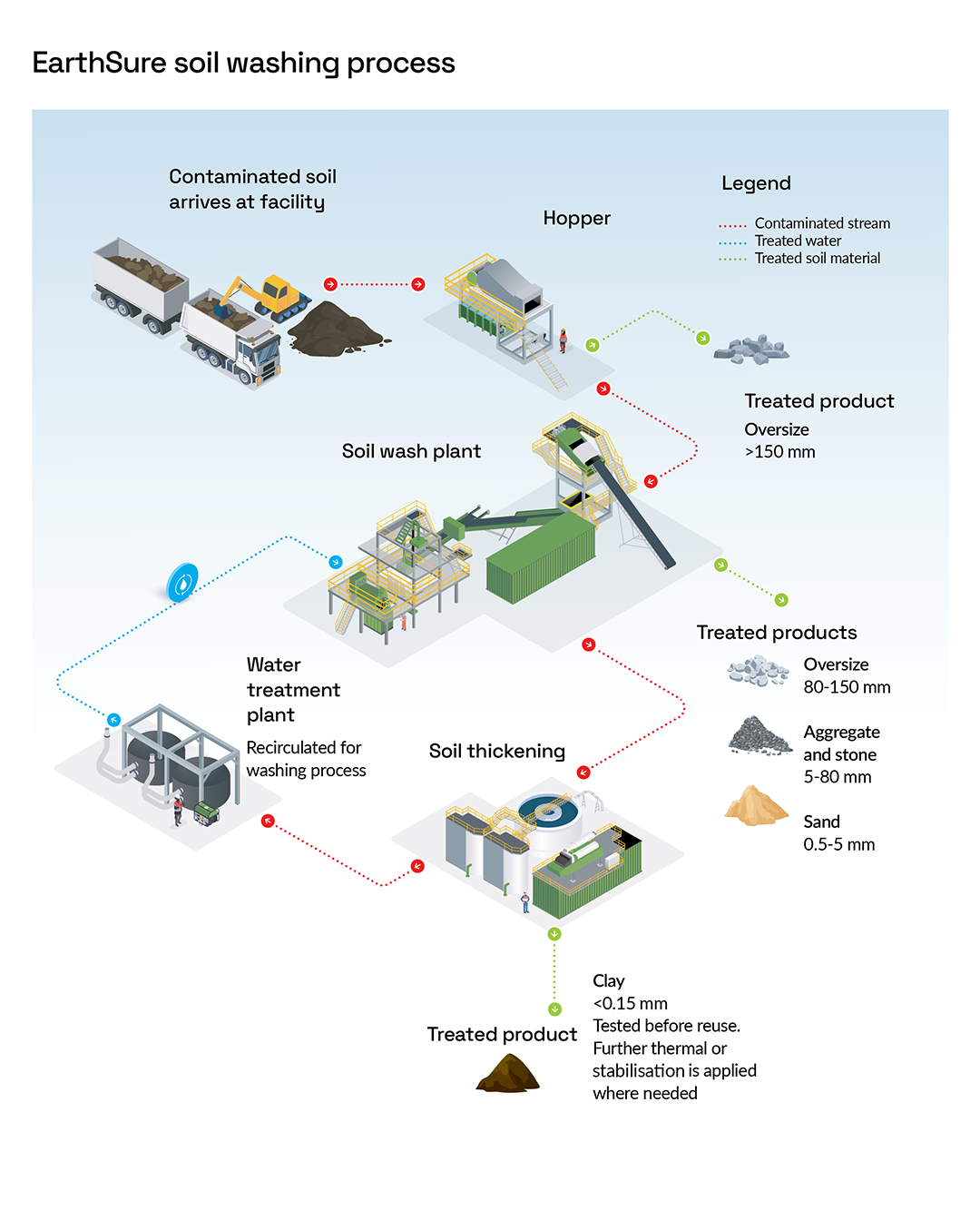
“With the [EPA] levy being where it is, it became a commercial decision and an opportunity to still play in the market, by looking at recovering the material rather than just disposing of the landfill,” Globan said.
“We’ve been able to extract resources out of that material to then go back out to market: sand that would usually be mined has been recovered and has gone into concrete manufacturing. We also receive railway ballasts from rail jobs; we recover that, and then that gets reused in road base.”
By combining the desorption plant and the soil-washing facility into one site, EarthSure functions as a one-stop shop for operators looking to dispose of contaminated soil as well as collect a sustainable source of new construction material.
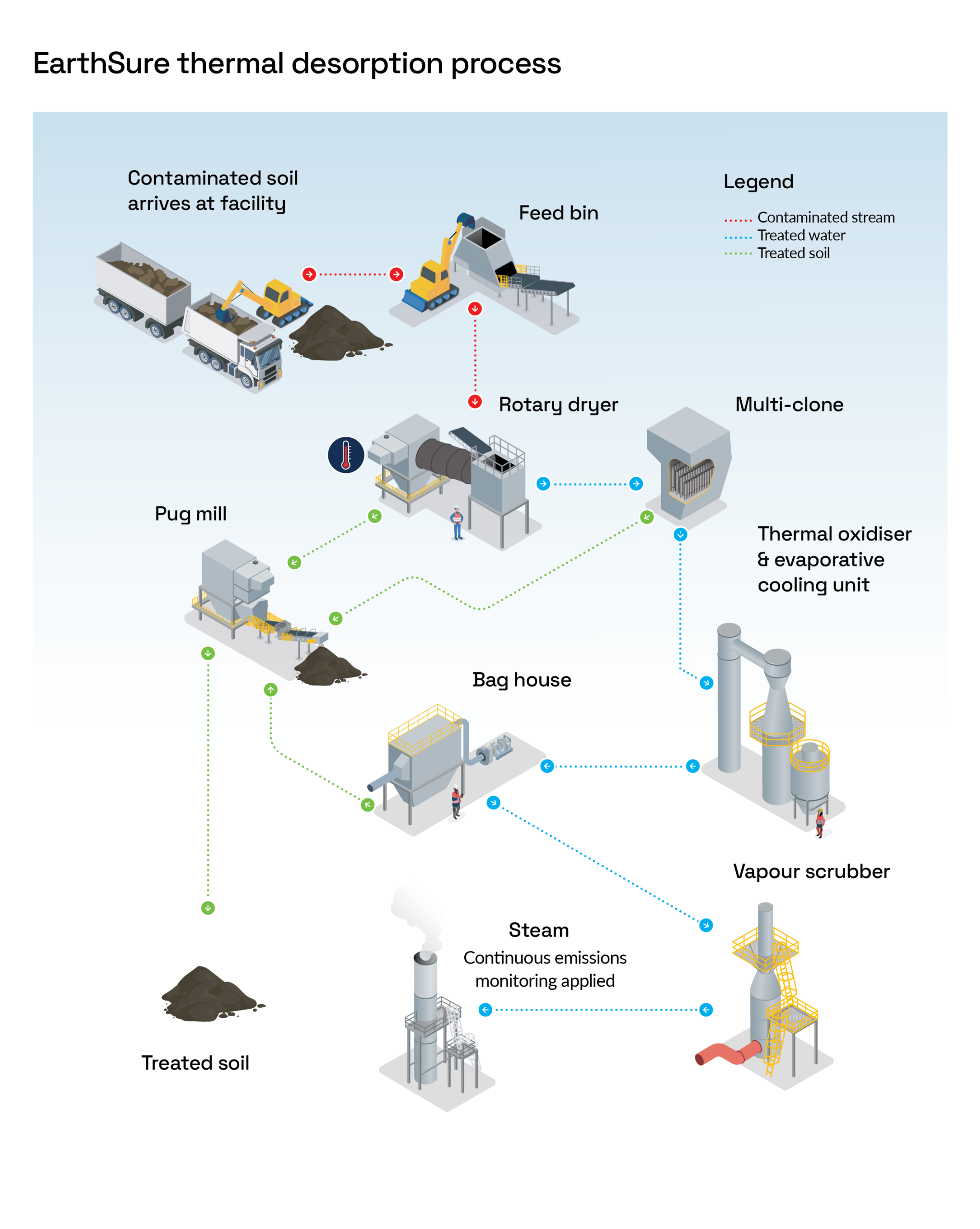
The desorption plant is designed to handle category A and B waste, the most polluted class, which can’t be sent to landfill. The desorption process cooks the contaminated material to more than 750 degrees Celsius, converting the contaminants to gas, allowing them to be separated, and leaving behind a thermally treated material suitable for being placed in pavements and road base as a subgrade.
“We have the ability to thermally treat contaminated soils, but also stabilise them through our thermal plant,” Globan said. “Customers can come in, drop soil off, and pick up recovered sand and go back to the same project.”
Powerful against PFAS
EarthSure’s thermal desorption plant is particularly notable for its ability to produce useful products from some quite toxic soil.
Soil contaminated with PFAS, for instance, is classed as category A or B. PFAS are also known as forever chemicals due to the difficulty of removing them from an environment – including the human body, where they can have carcinogenic effects, as well as causing other health issues.
PFAS are particularly associated with fire-fighting foam, and areas such as airports and military bases, where this foam has been deployed, can be seriously polluted by any PFAS that has leached into the soil. However, because PFAS are found in a wide variety of products, they are commonly found in groundwater, wastewater and soil across many locations.
“PFAS is a contaminant of concern, and we have proven that we’re able to destroy PFAS from the soil,” Globan said.
“Where we’re different is that we can actually capture the PFAS, and the benefit of having the thermal plant is we can then treat it onsite. But compared to other players in the market, we’re able to capture the PFAS through our water treatment phase.”
Since the PFAS is treated at EarthSure, the facility is able to reuse the water that’s used to extract the material, rather than continually drawing on a new supply. That’s another way the facility is greener than comparable services, according to Globan.
“PFAS isn’t soluble; it transfers in water,” he explained. “It becomes suspended in the water, and goes through a series of filters – like a pool filter. It is caught up through GAC, or granulated activated carbon.”
Once sufficient quantities of PFAS have been absorbed by the GAC, the material is removed to the thermal plant for destruction.
“We’re comfortable that the material that we’re recovering – rocks, aggregates, sands – do not contain any of those contaminants,” Globan said. “That’s all done by third-party testing.”
Circular systems
Much of the material managed at EarthSure is produced by the series of major rail and road projects that form Victoria’s Big Build infrastructure program, but Globan adds that the facility also draws customers that handle other work.
“There are gasworks projects that are remediating those sites across the state, through to commercial developers who have purchased brownfield sites and need to remove contamination,” he said.
Many Big Build projects are also required to use a particular percentage of recovered material, which encourages them to return to EarthSure to buy back the processed sand and soil, rather than to purchase it new directly from quarries.
In future, Globan said, EarthSure hopes to get approval to treat biosolids. That would have the benefit of providing the thermal desorption plant – which is currently powered by natural gas – with a greener source of energy.
“Biosolids have PFAS in them, but also have a high calorific value just by the nature of them,” he said. “What that means is that, when they get heated, you’re creating more energy, so you don’t have to use as much gas.”
This story was originally published in the August 2026 edition of create with the headline “Down in the dirt”.
WEBINAR: Forever chemicals (PFAS) in our environment – update on risks and implications